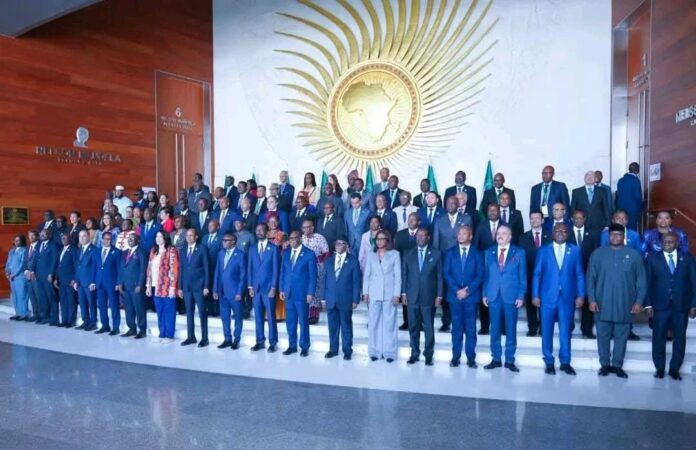
The Forty-Ninth Ordinary Session of the Executive Council of the African Union (AU) officially commenced today at the AU Headquarters in Addis Ababa. The two-day gathering brings together foreign ministers, heads of AU organs, United Nations representatives, and international partners to deliberate on strategic agenda items designed to accelerate the implementation of Agenda 2063. Central to the ongoing discussions is the evaluation of the AU Theme of the Year, which focuses on assuring sustainable water availability and safe sanitation systems across the continent to combat vulnerabilities arising from climate change and urbanization.
In his opening address, Mahamoud Ali Youssouf, Chairperson of the African Union Commission (AUC), welcomed delegates and emphasized that the Council is convening amid a landscape of heightened global uncertainty and complex geopolitical shifts. Addressing regional peace and security, Chairperson Youssouf expressed deep concern regarding the persistent spread of terrorism and violent extremism, referencing his recent solidarity missions to the Sahel to reaffirm the AU’s support for affected Member States.
Furthermore, he commended the Permanent Representatives Committee for its administrative diligence and urged member nations to expedite the ratification of outstanding legal instruments to strengthen the Union’s institutional framework.
Highlighting Africa’s evolving diplomatic standing, Ambassador Édouard Bizimana, Minister of Foreign Affairs of Burundi and Chairperson of the Executive Council, underscored that the continent is firmly asserting its role as a primary actor in global affairs. Ambassador Bizimana characterized Africa’s recent inclusion in the G20 as a historic milestone in global economic governance, asserting that global governance remains ineffective without direct African participation.
He further called upon Member States to project a unified diplomatic front and consistently defend the Ezulwini Consensus and the Sirte Declaration to advance long-overdue reforms within the United Nations Security Council.
Building upon the theme of continental self-reliance, Gedion Timothewos, Minister of Foreign Affairs of Ethiopia, addressed delegates by stressing the necessity for the African Union to operate as a strategic actor capable of generating indigenous solutions to global challenges.
Minister Timothewos outlined vital structural priorities, emphasizing the importance of political ownership over internal reforms, long-term financial independence, and the responsible stewardship of Africa’s natural resources. His remarks reinforced the overarching objective of positioning the Union as a credible and authentic voice for the continent.
Echoing the imperative of economic self-sufficiency, Claver Gatete, Executive Secretary of the United Nations Economic Commission for Africa (UNECA), briefed the Council on the necessity of funding continental development primarily through internal mechanisms.
Gatete noted that UNECA continues to champion domestic resource mobilization as the critical foundation for structural transformation and industrialization. He stressed that scaling up regional integration and productive capacities is essential for achieving both the Sustainable Development Goals and the targets set forth in Agenda 2063.
As the session progresses, the Executive Council will transition into closed meetings to review specialized committee reports and strategic financial frameworks. The agenda includes evaluations from the Committee of Fifteen Ministers of Finance, the Ministerial Follow-up Committee on Agenda 2063, and initiatives concerning African candidatures within international organizations.
Additionally, the Council will review appointments for the Board of External Auditors and finalize foundational documentation ahead of the upcoming 8th Mid-Year Coordination Meeting between the AU, Regional Economic Communities, and Regional Mechanisms.