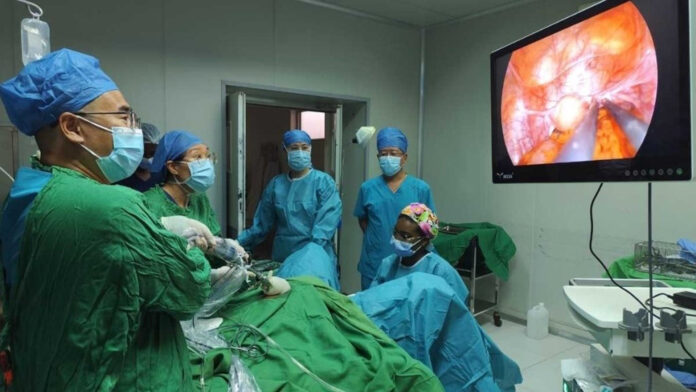
The 26th Chinese Medical Team stationed in Rwanda has successfully performed what local medical authorities have heralded as the country’s first-ever transumbilical single-port laparoscopic bilateral tubal sterilization.
The groundbreaking surgery took place on Tuesday at Masaka Hospital, located in Rwanda’s capital city of Kigali. The procedure was officially recognized by the Rwanda Society of Obstetricians and Gynaecologists as a historic medical first for the nation, showcasing both the high level of skill possessed by the visiting medical team and their remarkable ability to innovate under resource-constrained conditions.
Laparoscopic tubal sterilization is a minimally invasive surgical procedure that provides permanent contraception by blocking, sealing, or cutting both fallopian tubes. Traditional laparoscopic surgeries often require multiple small incisions in the abdomen to insert various instruments and cameras. However, this advanced single-port technique allows surgeons to perform the entire operation through a single, highly specialized entry point.
The patient at the center of this medical breakthrough was a 30-year-old Rwandan woman who had previously given birth to six full-term children and had no prior history of major abdominal surgeries. Seeking a permanent form of contraception, she voluntarily requested the procedure and expressed a strong personal preference for a technique that would leave as little visible scarring as possible.
Recognizing the patient’s unique wishes, the Chinese medical team initiated a thorough evaluation process. After carefully assessing Masaka Hospital’s current medical resources and equipment availability, the team convened a multidisciplinary consultation. They ultimately selected Yu Yang, an experienced obstetrician and gynecologist, to lead and perform the delicate operation.
Despite the team’s extensive clinical expertise, a significant logistical hurdle stood in their way: Masaka Hospital lacked a dedicated, commercial single-port laparoscopic access platform and faced a shortage of specialized surgical consumables typically required for such advanced procedures.
Refusing to let resource limitations compromise patient care, the innovative medical team engineered an ingenious solution. They successfully improvised a custom access channel using standard, sterile surgical gloves and basic suction tubing. This resourceful adaptation allowed the surgical team to smoothly insert, maneuver, and operate their instruments inside the patient while successfully maintaining the pneumoperitoneum—the medically controlled inflation of the abdominal cavity with gas that is absolutely critical for safe laparoscopic visualization and operation.
Working with this improvised setup, Dr. Yu and the medical team made a mere 1.5-centimeter incision meticulously concealed within the natural folds of the patient’s navel (the umbilicus). Through this tiny opening, they performed electrocoagulation and successfully transected both of the patient’s fallopian tubes. To fulfill the patient’s desire for minimal cosmetic impact, the incision was meticulously closed using fine cosmetic intradermal sutures to eliminate prominent scarring.
The operation concluded as an unmitigated success. The patient experienced a smooth and rapid postoperative recovery, was closely monitored by the medical staff, and was successfully discharged from the hospital the very next day.
Overjoyed with the results and the absence of noticeable scarring, the patient expressed profound gratitude toward the Chinese medical team. Upon her discharge, she repeatedly thanked the doctors in Kinyarwanda, telling them “Murakoze cyane”—which translates to “Thank you very much.”
Beyond the immense positive impact on an individual patient’s life, healthcare experts note that this successful operation carries broader implications for the region. The team demonstrated that high-end, minimally invasive surgical techniques are not exclusively restricted to heavily funded, high-tech medical centers. By combining advanced clinical training with clever resourcefulness, medical teams can successfully expand patient access to cutting-edge healthcare options even in facilities facing equipment constraints.
The 26th Chinese Medical Team continues to work closely with local Rwandan healthcare professionals, strengthening medical ties and sharing best practices to improve clinical outcomes and elevate healthcare standards across the nation.