Health authorities in Kenya reported a critical escalation in their efforts to contain an Ebola virus threat after confirming four new infections, bringing the total number of confirmed cases in the country to seven. Most concerning among the newly confirmed cases are three healthcare professionals who contracted the deadly pathogen while providing care to the nation’s index case.
According to an official statement issued on Saturday by Kenya’s Ministry of Health, all four new patients tested positive while in isolation and have been swiftly moved to dedicated treatment wards to receive specialized care. The fourth newly identified patient was a known contact of the initial case who was already undergoing strict quarantine protocols when symptoms developed. Meanwhile, officials confirmed that two previously diagnosed patients remain isolated and in stable condition.
The source of the local transmission traces back to a 40-year-old Kenyan national who arrived in the country from the neighboring Democratic Republic of Congo (DRC). The man fell severely ill shortly after his return and tragically passed away on October 5, just days after seeking treatment at a medical facility in Nairobi.
The outbreak across Central and East Africa has raised widespread alarm among global health experts, largely due to the specific pathogen involved. Laboratory testing confirmed that the current strain is the rare Bundibugyo ebolavirus. Unlike the more common Zaire ebolavirus—for which approved vaccines and therapeutics were developed in recent years—there are currently no regulatory-approved vaccines or specific antiviral treatments available for the Bundibugyo strain. This absence of specialized medical countermeasures leaves medical teams relying entirely on supportive clinical care, such as fluid rehydration, symptom management, and aggressive monitoring.
The infection originated in the DRC, where a devastating resurgence of Ebola has raged since May, claiming more than 4,300 lives and accounting for nearly half of all confirmed cases in that country’s recent epidemic. Given the extensive travel and cross-border trade networks in East Africa, public health agencies had been on high alert for potential cross-border spillovers.
In response to the primary patient’s diagnosis and subsequent death, epidemiological response teams embarked on an intensive contact-tracing operation. The ministry revealed that approximately 130 individuals were identified as having come into direct or indirect contact with the index patient. Out of those, 128 individuals were successfully placed under supervised quarantine, while health workers continue active field operations to locate and assess the remaining two individuals.
Ebola is a severe and often fatal viral hemorrhagic fever that spreads through direct contact with blood, saliva, vomit, or other bodily fluids of an infected person, as well as contact with contaminated surfaces or materials such as bedding and medical equipment. The infection of frontline health workers underscores the immense personal risks medical staff face when treating suspected hemorrhagic fever cases prior to definitive laboratory confirmation.
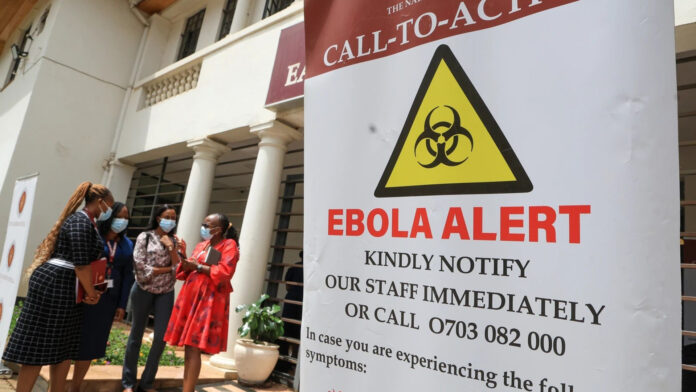
To halt further spread and prevent widespread community transmission, the Kenyan government has dramatically scaled up nation-wide preparedness measures. Enhanced screening protocols, including non-contact thermal scanning and symptom questionnaires, have been implemented at point-of-entry border crossings, international airports, and major transit hubs. In addition, health officials launched a national toll-free emergency hotline, urging citizens to report suspected symptoms—such as sudden fever, severe fatigue, muscle pain, vomiting, and unexplained bleeding—or notify authorities if they believe they have interacted with anyone exposed to the virus.