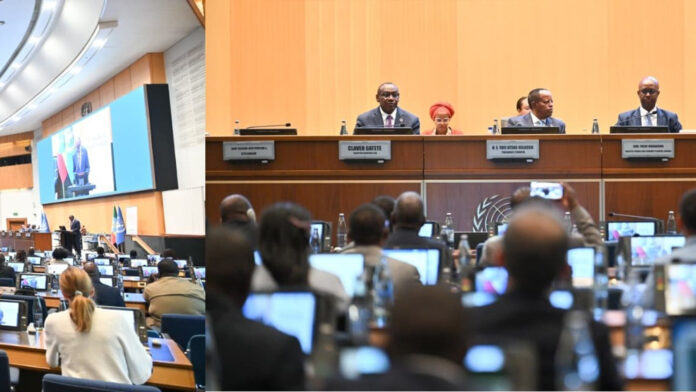
The tenth session of the Statistical Commission for Africa (StatCom-Africa) officially opened today at the United Nations Conference Centre in Addis Ababa, convening heads of national statistical offices, geospatial agencies, policymakers, and development partners from across the continent under a theme that challenges African nations to make official statistics a genuine reflection of reality: “Unleashing the Value of Data in Africa: Making Official Statistics a True Mirror of the Continent.”
The session is being held jointly with the twelfth meeting of the Regional Committee of United Nations Global Geospatial Information Management for Africa (UN-GGIM: Africa), which carries the theme “Seeing Africa Clearly: Unleashing Africa’s Spatial Intelligence for Integrated, Trusted and Actionable Data.” The week’s programme also includes the twelfth session of the Forum on African Statistical Development (FASDEV).
StatCom-Africa, established in 2005 by the ECA Conference of Ministers, serves as the highest decision-making body for statistics on the continent, responsible for setting statistical standards and developing the concepts and methods used at national, subregional, and continental levels. This year’s gathering carries particular urgency: Africa is producing more data than ever, yet much of it remains unintegrated, insufficiently trusted, or poorly utilised to inform decisions and improve livelihoods.
In his opening remarks, Taye Atske Selassie, President of the Federal Democratic Republic of Ethiopia, emphasised the importance of measuring development through reliable data and called for statistical systems that are responsive, trusted, and fit for an increasingly digital future. Rwanda’s Minister of Finance and Economic Planning, Yusuf Murangwa, stressed that strong statistical systems are essential to addressing Africa’s development challenges, urging investment and collaboration to ensure data translates into tangible results.
Claver Gatete, Executive Secretary of the Economic Commission for Africa (ECA), delivered a pointed critique of conventional measurement frameworks. “Data is not an end in itself. Its value lies in informing decisions, reaching underserved communities, and creating opportunities for inclusive growth,” he said. Gatete illustrated the gap between official figures and lived reality by citing Africa’s labour market: the continent’s unemployment rate stood at 6.3 per cent in 2025, yet 84.4 per cent of employment was informal—a disparity that unemployment statistics alone cannot capture.
He urged countries to modernise census and civil registration systems, safeguard statistical integrity as new technologies such as artificial intelligence are adopted, integrate statistical and geospatial data, and provide predictable financing for national statistical systems. ECA, through its African Centre for Statistics, will work with national statistical offices and partners to mobilise that financing.
The joint session with UN-GGIM: Africa reflects a growing recognition that statistical and geospatial data must be integrated to be truly actionable. The geospatial committee’s twelfth meeting aims to strengthen collaboration between the statistical and geospatial communities, promote innovation and adoption of emerging technologies, enhance policy coherence, and advance sustainable financing mechanisms.