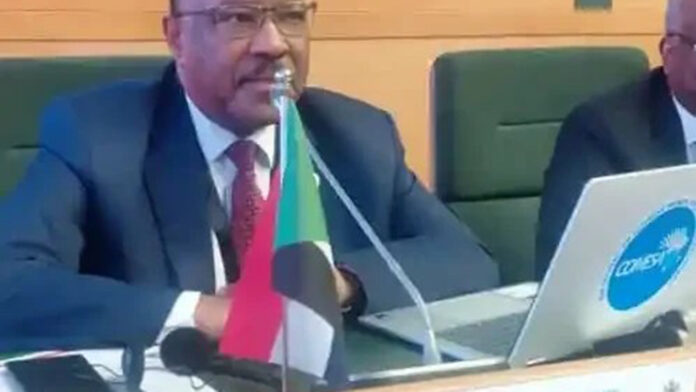
Sudan’sMinister of Foreign Affairs and International Cooperation, Ambassador Mohieddin Salem Ahmed Ibrahim, led the Sudanese delegation at the 21st Meeting of Foreign Ministers of the Common Market for Eastern and Southern Africa (COMESA), held in the Zimbabwean capital, Harare. The meeting brought together foreign ministers, heads of delegations, and the organization’s Secretary-General to address pressing regional issues, with Sudan’s security situation emerging as a central focus.
In his address to the assembled ministers, Ambassador Ibrahim reaffirmed Sudan’s firm position that the Rapid Support Forces (RSF) should be accurately and explicitly described as a “rebel militia” in regional documents and deliberations. He cited the grave crimes and violations committed against civilians and the systematic destruction inflicted on infrastructure across the country. The minister’s call reflects Khartoum’s sustained diplomatic push to reshape how the RSF is characterized in African and international forums, arguing that precise terminology is essential to holding the group accountable.
The Sudanese foreign minister extended an invitation to his COMESA counterparts to visit the capital, Khartoum, to witness firsthand the scale of destruction and damage caused by the militia’s attacks on the country and its institutions. The invitation underscored Sudan’s desire to ground regional discussions in direct observation of the conflict’s humanitarian and infrastructural toll.
Beyond the immediate security file, Ambassador Ibrahim stressed the importance of strengthening African coordination and joint action through a unified regional mechanism to address security and political challenges. He called for a collective approach to confronting rebel movements and cross-border terrorist groups that exploit crises to smuggle goods, undermine economic stability, and drive up the cost of living. The minister also urged greater regional cooperation to combat organized crime and drug trafficking and to address threats facing African communities—particularly women, young people, and the elderly—who remain vulnerable to exploitation amid poverty and precarious living conditions.
The minister emphasized the close link between peace, security, and development, noting that stability across the region is essential for successful economic integration, expanded intra-African trade, food security, and border protection. He urged COMESA member states to unify their visions and positions on common threats, thereby strengthening the continent’s capacity to address crises and achieve lasting stability.
At the conclusion of its sessions, the COMESA Council of Ministers adopted recommendations concerning the report on the state of peace and security in Sudan and the region. The recommendations affirmed respect for Sudan’s sovereignty, territorial integrity, and the independence of its national institutions, while categorically rejecting foreign interference and military and financial supplies to armed parties and militias. The Council also called for coordination among COMESA, the African Union, and African-led peace initiatives to prevent competing negotiation tracks, and underscored Sudan’s strategic importance to regional security, intra-African trade, food security, and border protection.
Further recommendations included support for the technical and logistical arrangements required to return the permanent headquarters of the COMESA Court of Justice to Khartoum. The Council also called for mobilizing African development institutions and the private sector to contribute to Sudan’s recovery and reconstruction, supporting the restoration of stability and strengthening development and economic integration across the region.