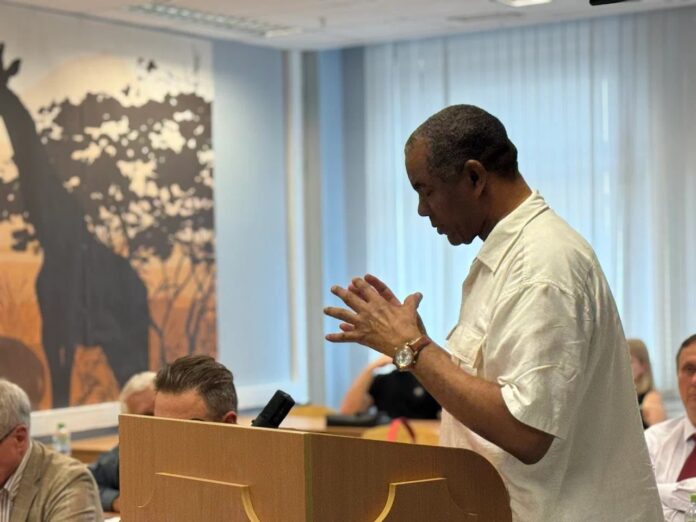
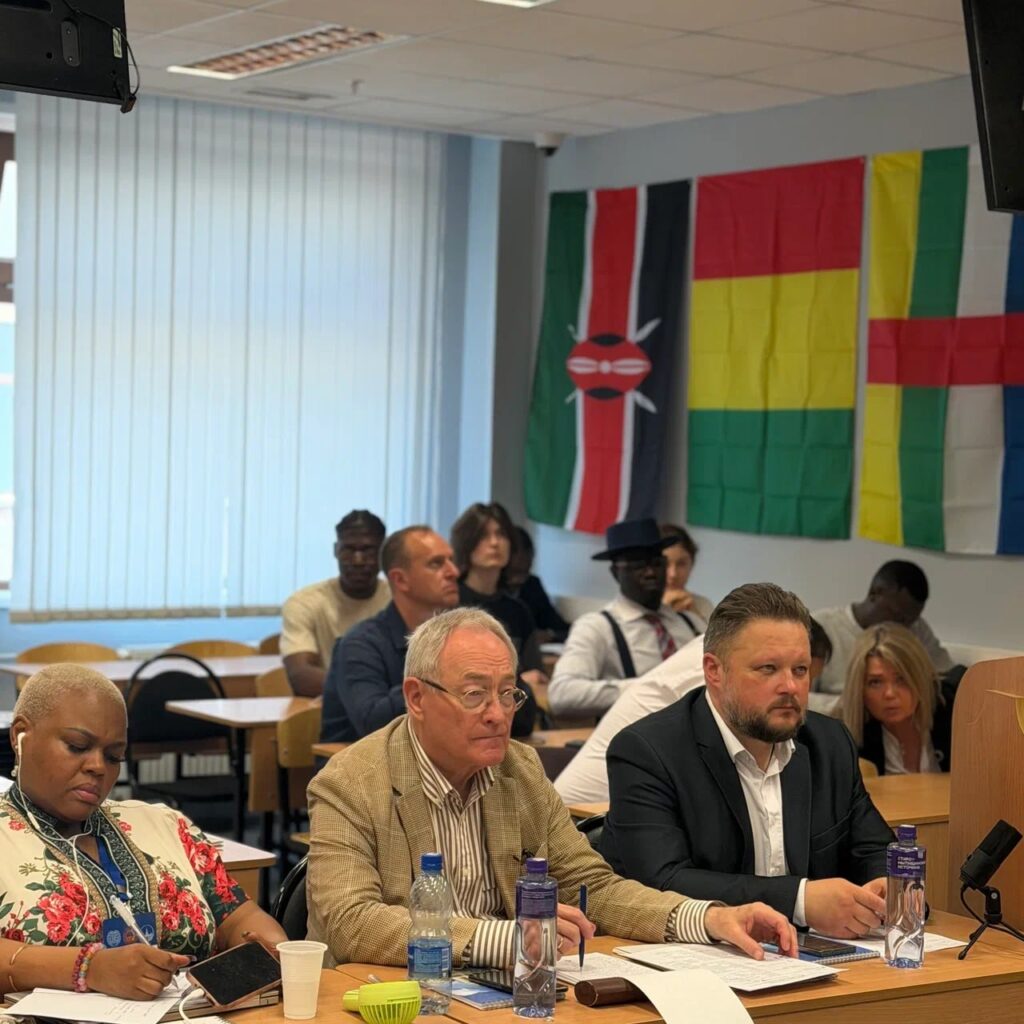
On May 22, a strategic session titled “The Role and Place of Africa in the Formation of a Polycentric System of International Relations” was held at the Faculty of Global Studies at Lomonosov Moscow State University as part of the VIII International Scientific and Practical Conference, “Current Problems of Global Research: Megatrends of Global Development.”
The session was organized by the Russian-African Club of Lomonosov Moscow State University in partnership with the Public Diplomacy Foundation and the Globus-21st Century Research and Educational Center of the Faculty of Global Studies at the university.
The session participants were welcomed by Professor Ilya Vyacheslavovich Ilyin, Dean of the Faculty of Global Studies and First Vice President of the Russian-African Club of Lomonosov Moscow State University. He emphasized the critical role of African countries in the formation of a new system of international relations.
The dean noted that students at the Faculty of Global Studies study Swahili and that other African languages are planned. He also drew attention to the African-inspired design of the new auditorium at the faculty, where the session was held, and proposed naming it after the distinguished African figure, Professor Amadou-Mahtar M’Bow, former Director-General of UNESCO from Senegal. M’Bow was a close friend of Russia and visited the country on numerous occasions. In 1977, he was awarded an honorary doctorate by Moscow State University.
Alexander Fedorovich Berdnikov, Executive Secretary of the Russian-African Club at Moscow State University, noted that the session was timed to coincide with the anniversary of the opening of the Faculty of Global Studies at Moscow State University, which took place on May 21, 2005. Over the years, the faculty has achieved significant results and become one of the most sought-after academic programs. He also stressed that the session was being held ahead of the Third Russia-Africa Partnership Summit, scheduled for Moscow in October 2026. All Club events this year, he said, are being organized under the auspices of this important event.
On the eve of the session, a meeting of the organizing committee for the Third Russia-Africa Summit was held, during which the results of the Second Summit were reviewed. It was noted that, despite the difficult international situation, Russian-African cooperation continues to maintain positive momentum.
Professor Nightingale Lulu, Head of the Department of Sociology and Anthropology at the University of Limpopo in South Africa, highlighted the importance of such meetings, describing them as a strong example of cooperation in the humanitarian sphere. According to her, the peoples of Russia and Africa are moving toward a common goal: creating a just world in which notions of exceptionalism for some members of the human community, and the condemnation of others to oppression, are not tolerated. She said all peoples must have equal access to the latest technologies, quality healthcare, education and the achievements of progress.
Kuznetsov Alexey Andreevich, Corresponding Member of the Russian Academy of Missile Forces and Artillery and Candidate of Historical Sciences, said the extremely tense international situation is increasing the risk of a nuclear catastrophe that could affect the entire world. In this regard, he argued, the importance of all tools, including soft power, capable of helping mitigate global conflicts, is growing. Cinema, he said, is one such tool. He presented a presentation on the theme of nuclear apocalypse in U.S. film production. He expressed hope that the release of the new film House of Dynamite could encourage new treaty-based agreements on disarmament and non-proliferation.
Professor George Mutalemwa, Head of the webinar “Global Research on Peace Problems for Sustainable Development” and professor at St. Augustine University of Tanzania, spoke about the work of the non-governmental organization Solidarity for Peace and Development and its foundation, whose activities he coordinates. He said the organization operates on four continents, conducts research on initiatives aimed at supporting peace processes, organizes conferences with activists from different countries and devotes significant attention to international educational projects. He also praised the Russian-African Club of Moscow State University for its efforts in supporting humanitarian projects and expressed his organization’s full support for the Club’s activities.
Professor Igor Erikovich Krugovykh, chairman of the international public movement “Mirosozidaniye,” said the parameters of a new world order include the need to create a more united global community, recognition of the unconditional identity and sovereignty of each state, and the principle of indivisible and equal security for all members of the global community, where disputes are resolved peacefully. He thanked his colleague from Tanzania and the organization he represents for their efforts to promote peace processes and invited Professor George Mutalemwa to become co-chair of the movement to coordinate joint efforts in this direction.
Richard Silumbe, a Zambian presidential candidate, president of the Leadership Movement political party and a graduate of Moscow Power Engineering University, said cooperation between Russia and Africa, particularly Zambia, remains underdeveloped in many areas. He expressed hope for expanded joint work in areas such as energy and peaceful nuclear research, which he said would help reduce Zambia’s and Africa’s dependence on hydropower, given the continent’s shortage of fresh water. He also said the Zambian president had recently refused to sign a document that would have transferred the country’s natural resources to President Donald Trump in exchange for U.S. assistance in developing Zambia’s healthcare system. According to him, this shows that Africa is beginning to awaken and is no longer allowing the West to force unfair deals on African countries.
Kinfu Zenebe, President of the Union of African Diasporas in Russia, said Africa has every chance of becoming an independent center in the new global system, especially given that more than 60 percent of the continent’s population is young, with around 900 million people under the age of 35. He said several factors pose serious risks to the growth of African public consciousness, including the strong influence of Western culture and media, epidemics, limited access to healthcare, youth unemployment, and shortages of qualified teachers, research infrastructure, laboratories and educational materials. He added that Russia can play a decisive role in addressing these challenges.
Sergey Nikolaevich Chesnokov, President of the ANO “MIR,” an academician of the Academy of Social Sciences and an international journalist for the newspaper Selskaya Zhizn, said the sovereignty of African countries, both political and economic, is the most important factor in Africa’s emergence as an independent center in a polycentric system. He cited independent payment systems, political, economic and information security, and emphasized the need for internal consolidation across African countries and the development of their own agenda in international relations.
Hafiz Bassi, head of the Youth Affairs Commission of the Russian-African Club of Moscow State University, said Africa’s place in the modern world is determined not only by its resources and population size, but also by the active development of self-awareness and identity, which contribute to political development and technological breakthroughs. He said Africa is increasingly becoming a key center in the formation of a new system of international relations. Africa, he added, is no longer merely the object of external decisions, but is increasingly emerging as an independent actor capable of defining its own priorities and influencing the global agenda.
Hussein Mudri, Secretary of the Department of Interpretation and Translation at the Ministry of Foreign Affairs of Niger and a graduate of Moscow State University named after V.S. Chernomyrdin, spoke about the role of Russian language diplomacy in strengthening relations between Africa and Russia. He said Russian language diplomacy is expressed through Russian language teaching in Africa, university programs, cultural centers, Russian-language media, and academic and cultural exchanges. In addition to soft power tools, he stressed the crucial role of strategic assistance Russia provides to Africa, particularly the Sahel countries. In recent years, he said, the Russian Ministry of Defense’s Africa Corps has played an increasingly important role in maintaining stability and combating terrorism in the Sahel, particularly in Niger. He added that the region faces serious security threats from terrorist groups, cross-border crime and political instability, making military and strategic cooperation with Russia especially important.
He said the Africa Corps participates in the training of national armed forces, strengthens defense capabilities, supports counterterrorism efforts, helps secure strategically important facilities and develops military-technical cooperation. For Niger, he said, this cooperation is an important element in strengthening national sovereignty and ensuring internal security. He added that security cooperation contributes to stronger diplomatic relations between Africa and Russia in a polycentric world.
Daniel Sawadogo, head of the branch of the Russian-African Club of Moscow State University named after M.V. Lomonosov in Burkina Faso and other countries of the Confederation of Sahel States, and former cultural attaché at the Embassy of Burkina Faso in Russia, presented his perspective on recent events in Mali. He said the events of April 25, 2026, in Mali serve as a stark reminder of the West’s hostility toward the Russian Federation, aimed at testing the effectiveness of its strategic support for the Sahel states or even inflicting a strategic defeat on it. He added that, thanks to the Russian Africa Corps, all cities in northern Mali, including Kidal, have been liberated from terrorists. He said the effectiveness of the Africa Corps on the ground is reflected in the growing professionalism of the confederate armed forces, which are improving through the exchange of experience and knowledge. He said this is worrying imperialist powers, which are now forced to recognize the Africa Corps as an important geopolitical and geostrategic reality.
Aliu Touankara, a public figure and member of parliament from Mali, said the Sahel is undergoing one of the most significant geopolitical transformations in its modern history. He said the Alliance of Sahel States, comprising Mali, Burkina Faso and Niger, is a strategic partner of the Russian Federation. The presence of the Africa Corps in the region, he said, is not intended to project foreign power but to protect and ensure regional security. It is, he added, a crucial force for political stabilization and the implementation of fundamental reforms. He said the second pillar of this partnership is absolute respect for national sovereignty, adding that Russia is taking a pragmatic approach by providing the means to victory without interfering in domestic governance. He also argued that lasting stability cannot be built solely through military force. Russia, he said, has understood this and is using soft power and economic cooperation alongside the Africa Corps. As a citizen of Mali, he expressed deep gratitude to Russia and to the Africa Corps of the Russian Ministry of Defense for saving his homeland from a new devastating military conflict.
Nikolay Alekseevich Sologubovsky, a prominent Africanist, journalist, writer and filmmaker with many years of experience in various African countries, said it is essential to use the Soviet Union’s experience in educating Africans, especially young people, to counter Western propaganda. He suggested publishing a book of reports by African journalists who visited the Special Military Operation zone in Donbas, where they could truthfully recount the reasons for the operation and what happened there. He said such a book would be especially important ahead of the Third Russia-Africa Partnership Summit. He also focused on the role of the Russian Ministry of Defense’s Africa Corps, citing the recent coup attempt in Mali, when Russian troops and the Malian army withstood the attack. He added that, as during World War II, African soil was stained with Russian blood, and that Russian soldiers died fighting terrorists hired by the West, meaning they died for the future of Africa and humanity.
Louis Gowand, Chairman of the Commission for Work with African Diasporas and Public Relations of the Russian-African Club of Lomonosov Moscow State University, said the formation of a polycentric system of international relations has now entered the stage of active implementation. In this new global architecture, he said, the African continent is not an object but a key and sovereign actor in global politics and economics. In this context, he added, Russia’s historical role as a reliable partner without a colonial past becomes especially important. The Russian Federation, he said, consistently acts as a guarantor of stability on the continent. Cooperation with Russia, he added, creates the secure conditions needed for long-term projects in agriculture, energy and infrastructure.
Ilya Leonidovich Shershnev, Director of Programs at the Russian-African Club of Moscow State University and Associate Professor in the Department of Global Social Processes and Youth Work, said public diplomacy plays a special role in the development of the Russian-African strategic partnership. Public diplomacy, he said, builds trust, fosters mutual cultural enrichment and strengthens friendly ties between peoples. It complements official diplomacy and expands opportunities for interaction among non-governmental organizations, youth, businesses and the academic community. One of the influential actors in public diplomacy, he said, is the Russian-African Club, founded in the summer of 2022 at Lomonosov Moscow State University, which today serves as a unique initiative to strengthen friendly relations and expand cooperation between Russia and African countries.