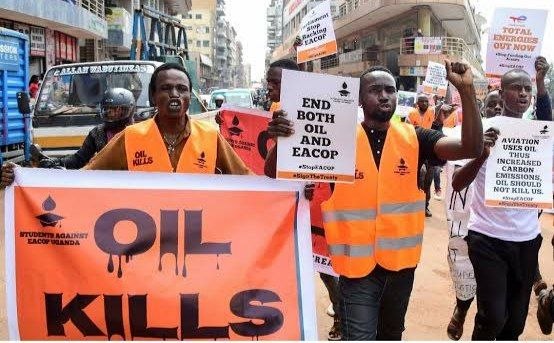
Four Ugandan smallholder farmers have initiated legal proceedings against EACOP Ltd in the High Court of Justice in London. The claimants are seeking a judicial injunction to halt the operations of the multi-billion-dollar East African Crude Oil Pipeline (EACOP) prior to its inaugural commercial export phase.
The case introduces a highly sophisticated jurisdictional strategy: petitioning a British court to directly adjudicate and enforce Ugandan domestic statutes—specifically its constitutional protections, environmental codes, and climate laws—against a corporate entity registered within the United Kingdom.
The infrastructure in question spans 1,443 kilometers (897 miles) and features an electrically heated pipeline design engineered to transport landlocked Uganda’s viscous, heavy crude from the Albertine Graben region to the marine port of Tanga in Tanzania.
Currently estimated at 80% completion, the $5.6 billion midstream project operates as a multinational joint venture. French energy major TotalEnergies holds the majority stake, alongside minority holdings split between the China National Offshore Oil Corporation (CNOOC), the Uganda National Oil Company (UNOC), and the Tanzania Petroleum Development Corporation (TPDC).
Crucially for the plaintiffs, day-to-day project operations are overseen by EACOP Ltd, which maintains its registered corporate headquarters in London’s Canary Wharf financial district. This UK incorporation establishes the definitive jurisdictional link enabling the London-based law firm Leigh Day to bring the action before an English forum.
The litigation is backed by the global advocacy organization Avaaz and financed through a crowdfunding campaign exceeding 40,000 individual contributors. The legal framework constructed by the plaintiffs relies strictly on the extraterritorial enforcement of host-country laws. The claim cites Article 39 of the Ugandan Constitution, which guarantees the right to a clean and healthy environment, alongside the National Environment Act of 2019 and the National Climate Change Act of 2021.
The 2021 climate legislation specifically provides a statutory mechanism for citizens to seek judicial remedies if an entity compromises national climate mitigation efforts. Given that independent environmental audits estimate the pipeline’s total value-chain lifecycle emissions at 379 million tonnes of carbon dioxide equivalent over a 25-year operational lifespan, the claimants contend that the project directly breaches Uganda’s binding domestic statutory climate frameworks.
In addition to systemic macro-climate arguments, the brief details significant localized environmental and socio-economic disruptions. Environmental impact assessments indicate the pipeline’s corridor intersects critical ecological infrastructure, including 158 wetlands, 11 primary river systems, and several designated protected areas. The plaintiffs, including farmer Racheal Tugume, assert that early-stage construction has compromised regional hydrological networks and agricultural land viability. Furthermore, the land acquisition process has impacted upwards of 100,000 individuals, leading to allegations from local civil society groups regarding delayed or inadequate compensation frameworks.
Legal experts close to the matter observe that the decision to file in a foreign jurisdiction reflects calculated concerns regarding the domestic judicial climate in Uganda, where legal challenges to state-backed energy infrastructure frequently face significant procedural delays.
Conversely, the London filing has met sharp institutional resistance from advocates of African energy infrastructure. The African Energy Chamber has formally condemned the litigation, with Executive Chairman NJ Ayuk characterizing the cross-border legal strategy as a form of regulatory overreach and “colonialism 2.0.” Proponents of the project argue that foreign-funded litigation infringes upon national economic sovereignty, disrupts
sovereign development agendas, and impedes emerging economies from leveraging their natural resource assets. They emphasize that commercializing Uganda’s estimated 6.5 billion barrels of crude reserves is a critical macroeconomic lever designed to fund essential public infrastructure, education, and healthcare systems. Although standard procedural timelines suggest a full trial in London could take up to 18 months, the plaintiffs are concurrently seeking an expedited emergency injunction. Legal counsel maintains that even if commercial operations commence later this year, the litigation remains a viable mechanism to secure a permanent cessation of operations, thereby capping the project’s long-term environmental and legal liabilities.