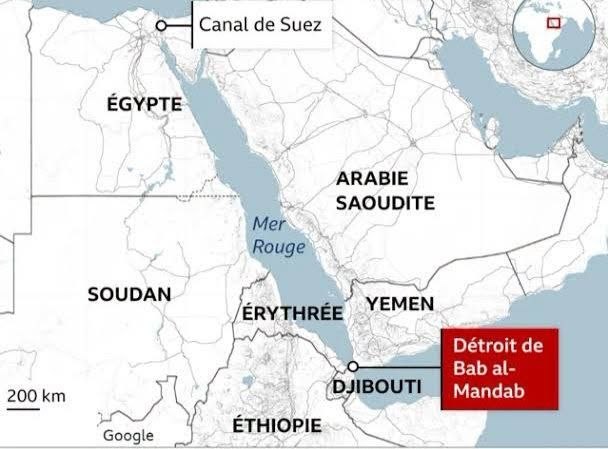
The government of Djibouti has issued a strong warning against any unilateral attempts to impose tolls, taxes, or charges on ships transiting the strategic Bab el-Mandeb Strait. In an official statement published by the state-run Djiboutian News Agency (ADI), the government stressed that any such measure would represent a direct violation of international law and pose a severe threat to the security of one of the world’s most critical maritime corridors.
Reaffirming its unwavering commitment to freedom of navigation, Djibouti underscored that the international legal framework governing straits used for international shipping must be rigorously upheld. The Bab el-Mandeb Strait, which separates the African and Asian coasts while connecting the Gulf of Aden to the Red Sea, is globally recognized as an indispensable passage that must remain completely open to international commercial traffic without arbitrary interference.
Beyond its general commercial significance, the waterway serves as a vital artery for global energy supplies. Data from the U.S. Energy Information Administration highlights the immense scale of commerce relying on the corridor. During the first half of 2025, an estimated 4.2 million barrels per day of crude oil and petroleum products passed through the Bab el-Mandeb. While this reflects a significant decrease from the 9.3 million barrels per day recorded in 2023—largely driven by regional instability—the route remains crucial for global energy security.
Furthermore, the impact of ongoing security threats has been starkly evident in liquefied natural gas (LNG) transport. Traffic through the strait plummeted to almost zero throughout 2024 and the first half of 2025, as commercial vessels actively rerouted to avoid escalating security risks and prohibitive insurance costs.
Against this fragile backdrop, Djibouti warned that any initiative by a single coastal state to impose transit charges on vessels navigating the strait would contravene established international legal norms. The government cautioned that such actions would undermine the sovereignty of neighboring nations and dangerously endanger maritime routes that are essential to sustaining global trade and energy networks.
As a neighboring country directly impacted by developments within the strait, Djibouti made it clear that it would view the implementation of any unilateral toll system as a direct challenge to the waterway’s established international status. The administration categorized such moves as an unacceptable escalation of tensions in an already volatile region.
To safeguard regional stability, the Djiboutian government formally reserved its right to utilize diplomatic, legal, and security channels. It noted it is prepared to act either independently or in close coordination with regional and international partners to protect its sovereign rights, maintain maritime safety, and preserve stability across the Red Sea.
Concluding its address, Djibouti issued an urgent appeal to the international community, relevant global organizations, and all regular users of the strait. It called for concerted efforts to ensure that the Bab el-Mandeb remains a safe, open passage strictly governed by international law, rather than a geopolitical tool utilized to exert pressure or advance narrow national interests.