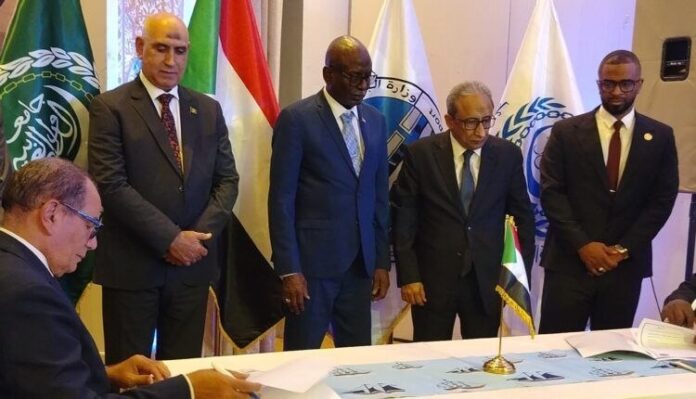
The Arab League announced preparations on Monday for a broad, multi-layered reconstruction plan aimed at rehabilitating Sudan’s devastated infrastructure and driving long-term economic stability. The announcement was made during a high-level assembly in Khartoum, coinciding with the launch of the Sudanese-Arab Smart Transport Forum.
The ongoing conflict has inflicted catastrophic damage across Sudan, severely crippling critical infrastructure including land, maritime, and air transport networks. This widespread destruction has severely hampered civilian mobility and created immense bottlenecks in the delivery of vital humanitarian assistance to vulnerable populations.
Addressing delegates at the summit, Mohammed Ahmed al-Ni, Secretary-General of the Council of Arab Economic Unity, outlined the pan-Arab organization’s structured strategy for rebuilding the nation.
He emphasized that the overarching recovery framework is built upon three fundamental tracks: immediate humanitarian aid, robust economic stabilization, and long-term infrastructure reconstruction. Crucially, al-Ni noted that smart transportation systems will form a core pillar of the entire initiative.
The high-level announcement aligned with the opening of the three-day Sudanese-Arab Smart Transport Forum, convened under the theme “Towards a Smart and Sustainable Partnership to Rebuild the Transport Sector.” The gathering brought together a wide array of stakeholders, including joint Arab action institutions, government bodies, and private-sector leaders, to foster public-private partnerships and accelerate regional economic integration.
According to al-Ni, active coordination is currently underway between the Arab League and specialized regional unions. This effort is designed to facilitate the direct involvement of major Arab corporations in reconstruction projects, building upon a prior Cairo initiative focused specifically on transport rehabilitation.
Al-Ni underscored that rebuilding Sudan remains a pivotal regional priority, requiring synchronized efforts among national governments, financial institutions, private enterprises, and technical experts to establish enduring stability.
Demonstrating readiness for partnership, Sudan’s Minister of Infrastructure and Transport, Saif al-Nasr Al-Tijani Haroun, presented a comprehensive portfolio of strategic transport initiatives to potential partners and investors. He strongly urged Arab financial institutions and private enterprises to expand their cooperation during this critical upcoming phase.
Haroun affirmed that his ministry is actively implementing an integrated strategic vision to modernize the national transport system. This ambitious modernization plan encompasses the full rehabilitation of roads, bridges, railways, seaports, river ports, and dry ports, with the ultimate goal of meeting international standards.
The ongoing forum aims to strengthen technical cooperation in smart transportation and logistics, showcase high-priority investment opportunities, and leverage private-sector expertise to fast-track Sudan’s recovery and reconnect its regional supply chains.