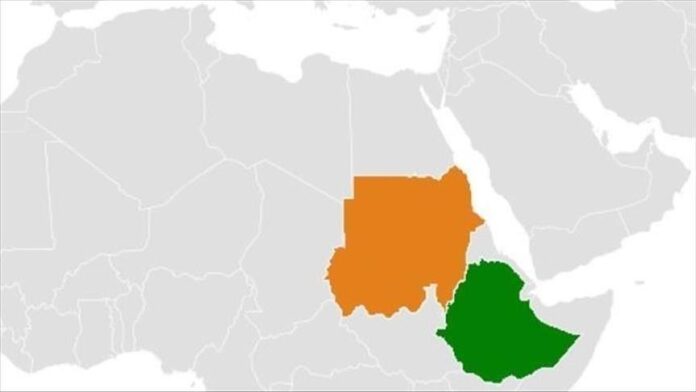
The Horn of Africa stands on a dangerous precipice as the long-standing friction between Sudan and Ethiopia has escalated into a full-blown diplomatic crisis.
In a move that threatens regional stability, Khartoum has officially recalled its ambassador to Ethiopia for consultations, citing alleged Ethiopian drone strikes. This tension risks drawing Sudan’s civil war into neighboring countries and involving Middle Eastern powers, posing a significant threat of sparking a regional conflict.
The primary catalyst for the diplomatic rupture is a series of drone strikes on strategic locations in Sudan. The Sudanese Army stated that several attacks, including Monday’s strike on Khartoum International Airport, originated from the Ethiopian border.
In a press conference held in the capital, Sudanese Army spokesperson Assim Awad stated that data recovered from a downed drone in El-Obeid, North Kordofan, reveals the aircraft launched from the vicinity of Bahir Dar Airport in northwestern Ethiopia. “The information is documented and undeniable,” Awad said. “Ethiopia and the United Arab Emirates have committed a direct aggression against Sudan; this will not be overlooked in silence.”
Mohieddin Salem, the Sudanese Foreign Minister aligned with the military, issued a stern warning, stating that Sudan is prepared to enter a “clear confrontation” with Ethiopia if the attacks continue.
Addis Ababa has dismissed the allegations as “baseless” and “intended to divert attention.” However, simultaneously, Ethiopia leveled heavy accusations of its own, claiming the Sudanese Army is arming and assisting Tigray People’s Liberation Front (TPLF) “mercenaries.”
The TPLF, which fought a bloody war with the federal government until a peace deal was signed in 2022, remains a sensitive national security issue for Prime Minister Abiy Ahmed’s administration. Ethiopia now alleges that Sudan is serving as a “logistics hub” for Tigrayan militants seeking to destabilize the Ethiopian border.
“The Sudanese armed forces are facilitating attacks along Ethiopia’s western border by providing weapons and financial support to these mercenaries,” the Ethiopian Ministry of Foreign Affairs said in a statement. By linking the Sudanese military to the TPLF, Ethiopia has framed the issue as an existential threat to its domestic peace rather than a mere border dispute.
Another major point of contention is the suspected involvement of the United Arab Emirates (UAE) in exacerbating the tension. For months, the Sudanese government has accused Abu Dhabi of supplying the Rapid Support Forces (RSF) with sophisticated weaponry—specifically combat drones.
Sudan’s latest allegations suggest a tripartite link involving UAE financial and technological support, Ethiopian territory, and RSF operators. While the UAE has repeatedly denied any military involvement in the Sudanese conflict, UAE markings found on the wreckage of downed drones have eroded the credibility of these denials within the international community.
This crisis comes at a time when the region is already mired in a severe humanitarian disaster. Sudan has been devastated by civil war since April 2023, displacing millions and pushing the country toward famine. Ethiopia, meanwhile, is recovering from internal conflicts in the Amhara and Oromia regions and a fragile peace in Tigray.
Regional security experts warn that the Sudanese conflict is now taking on a “globalized” character. “We are seeing two distinct war zones overlapping,” says security analyst Dr. Elena Vasky. “Sudan is using the Ethiopia-UAE connection to justify its battlefield losses, while Ethiopia is raising the TPLF issue to justify military movements on its western border. The probability of a direct war between the two nations is higher now than it has been in decades.”
As the diplomatic war of words intensifies, civilians are paying the ultimate price. Just as diplomats were being recalled yesterday, a drone strike on a fuel station in the city of Kosti, White Nile State, killed three civilians. This attack is part of the “drone warfare” that is causing widespread destruction of Sudanese infrastructure.
The international community has expressed deep alarm. Both the African Union and the United Nations have issued urgent calls for restraint and a return to the negotiating table. However, with the Sudanese ambassador heading home and Ethiopia doubling down on its “mercenaries” accusation, the path to diplomacy is narrowing.
For the people of Sudan, Ethiopia’s potential entry into the conflict represents a terrifying new chapter. For Ethiopia, it is an event that places its internal peace at grave risk.