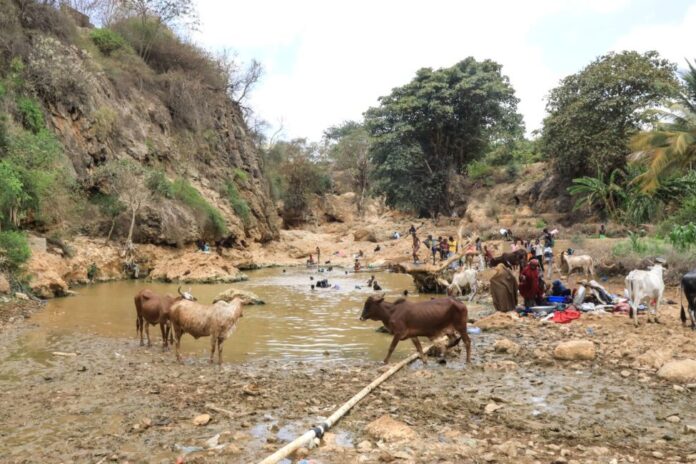
The worsening severe drought in Somalia is displacing a massive number of people from their homes. According to data released by the United Nations, nearly 62,000 people were displaced from five selected districts in the early months of 2026 alone.
The International Organization for Migration (IOM) issued a statement on Friday warning that although the recorded figures are concentrated in specific areas, the nationwide number of displaced persons could exceed 300,000. The primary drivers for this crisis are the drying up of water bodies and the mass death of livestock, which serves as the backbone of the Somali economy.
The crisis is currently most severe in the districts of Baidoa, Daynile, Kahda, Dinsoor, and Doolow. According to the organization, three out of four (75%) new arrivals at displacement sites cited the drought as the main reason for their flight. As consecutive harvest seasons have failed in these areas, rural residents have completely lost their livelihoods, forcing families to migrate to Mogadishu and similar cities in search of food and water.
Frantz Celestine, the IOM’s representative in Somalia, stated that the drought is causing crop failure and livestock depletion, noting that families are arriving at already overstretched displacement camps only after their water has run out, their crops have withered, and their animals have perished.
The humanitarian crisis is also manifesting as a severe food security emergency. Experts supported by the United Nations recently revealed that 6.5 million people—nearly one-third of the country’s population—are facing acute food insecurity. This represents a twofold increase compared to last year. Children are the most vulnerable; health experts estimate that over 1.8 million children will suffer from acute malnutrition this year. There are grave fears that the mortality rate for children under the age of five could rise significantly without urgent nutritional and medical assistance.
Despite the vast scale of the disaster, the international community’s response remains slow. IOM officials noted that only 14 percent of the total funds requested for humanitarian aid in Somalia has been secured so far. Consequently, the IOM has issued an urgent appeal for $10 million to provide immediate water, sanitation, and shelter services. Aid workers warn that time is running out to prevent a widespread famine.
The future remains uncertain. While the “Gu” rainy season from April to June is expected to bring above-average rainfall to some areas, experts worry this could present a different set of risks. Heavy rain falling on parched, hardened soil could trigger flash floods, causing further displacement and spreading waterborne diseases like cholera. Even if the rains are favorable, the long-term impact of the drought on the agricultural sector is expected to persist, with the organization estimating that an additional 125,000 people could be displaced in the coming months.