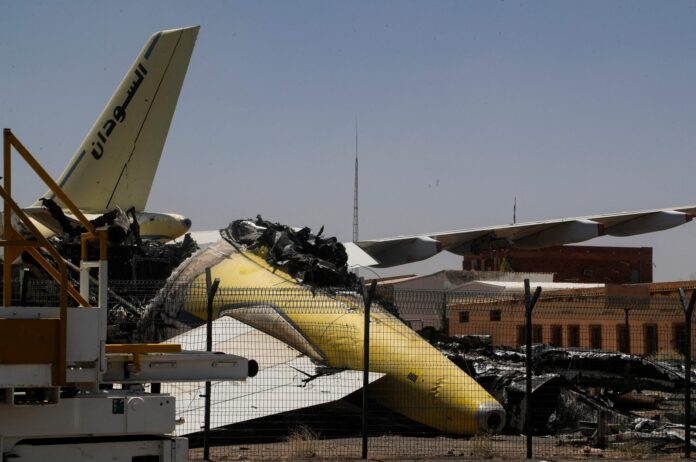
The United Arab Emirates (UAE) has strongly rejected accusations leveled by the Sudanese Armed Forces (SAF). The allegations claim the Emirates was involved in a sophisticated drone attack on Khartoum International Airport earlier this week. This denial has intensified the war of words between the two nations, raising fears that Sudan’s devastating civil war is shifting into a complex regional proxy conflict.
The attack occurred on Monday, May 4, 2026, involving a series of drone strikes that damaged the runway and surrounding infrastructure of the capital’s main airport. The airport had recently resumed limited operations after months of repairs, serving as a critical gateway for humanitarian aid and diplomatic movement.
In a statement on Monday evening, a spokesperson for the Sudanese Army claimed to possess wreckage images and flight data indicating the drones were UAE-manufactured. The Sudanese military further alleged that the drones originated from Bahir Dar Airport in neighboring Ethiopia.
A high-ranking UAE official responded to the allegations by dismissing them as “baseless fabrications.” In a statement released via the state news agency, the official characterized the claim as a desperate attempt by Sudan’s military leadership to divert international attention from its own internal failures.
“These accusations are part of a calculated diversion strategy; an attempt to pin the blame on others to avoid accountability for one’s own actions,” the statement read. It added, “The UAE remains committed to a peaceful solution and calls for a genuine ceasefire that prioritizes the safety of the Sudanese people.”
This diplomatic friction underscores the deepening severity of the war, now entering its third year. Sudan has repeatedly accused Abu Dhabi of providing logistical and military support to the Rapid Support Forces (RSF), led by General Mohamed Hamdan Dagalo. While the UAE has consistently denied these claims, UN investigators have previously pointed to “credible” evidence regarding arms transfers.
The attack on the airport has sent shockwaves through East Africa and the Middle East. Egypt and Saudi Arabia issued statements on Tuesday condemning the violation of Sudanese airspace and warning that interference from neighboring countries would only prolong the suffering of the population.
The mention of Ethiopia in the Sudanese Army’s narrative has become another source of geopolitical tension. Addis Ababa, alongside the UAE, was quick to deny the allegations, calling the claim that its territory was used as a launchpad for the attack “completely false.” However, the RSF’s recent territorial gains in the Blue Nile State near the Ethiopian border have fueled concerns that the conflict is evolving from an internal power struggle into a broader regional confrontation.
As the diplomatic standoff continues, the situation on the ground remains dire. Massad Boulos, a senior advisor to the U.S. administration, has reiterated calls for all foreign entities to cease support for the warring factions. Since April 2023, the war has displaced over 15 million people, and the country is facing what the United Nations has described as “the world’s worst hunger crisis.”
Military analysts suggest that the increased use of long-range drones indicates the war has moved into a new and more lethal phase. With Khartoum Airport once again becoming a center of conflict, the prospect of a negotiated peace appears increasingly remote.