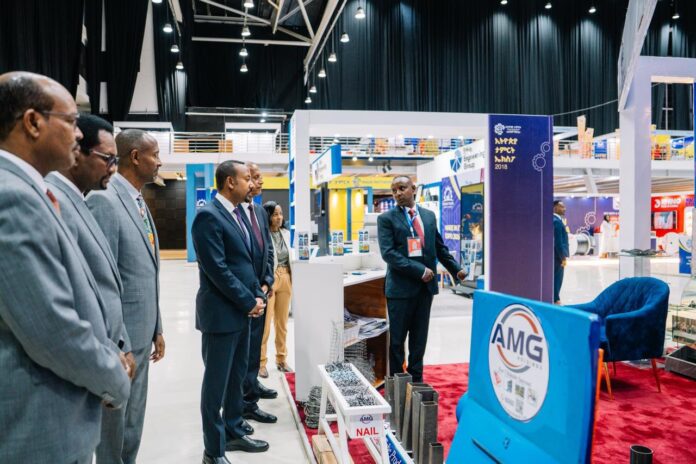
As a result of the industrial policies and Homegrown Economic Reform measures Ethiopia has implemented over the past few years beginning to bear fruit, the country has announced a plan to generate $5 billion in export revenue this budget year. This announcement was made during the recently held fourth ‘Made in Ethiopia’ Expo, noting that just three years ago, the country struggled with export performance that sat well below $3 billion.
In a message shared at the conclusion of the Expo and on his social media accounts, Prime Minister Abiy Ahmed stated that the primary reason for this significant revenue growth is the strengthening industrial sector and the success of the ‘Made in Ethiopia’ movement. According to the Prime Minister, alongside efforts to expand the export trade, the country is taking strategic steps to stabilize foreign exchange flow by replacing imported goods with domestic products.
The fact that Ethiopia’s industrial production capacity has surged from 47% to 67% over the past four years clearly demonstrates the sector’s revitalization. This improvement has enabled the country to attract more than 2,800 new domestic and Foreign Direct Investments (FDI). The manufacturing sector, in particular, is playing a vital role in meeting domestic demand in addition to creating vast job opportunities for citizens.
As reported by the Ethiopian News Agency (ENA), $14.5 billion in foreign exchange has been saved over the last four years through the use of import-substitute goods produced locally. The Prime Minister confirmed that the government has set a clear plan to double this figure in the coming years. The saving of nearly $4.85 billion in foreign exchange through import substitution in just the first nine months of the 2018 (E.C.) fiscal year is being taken as a key indicator of the strategy’s effectiveness.
Ethiopia has currently identified 96 specific products to be produced domestically with special focus. Among these is the ceramics industry; efforts are underway to replace products previously imported at a high foreign currency cost with local raw materials and labor. This is a major step toward reducing dependency on other sectors and correcting the trade balance.
Prime Minister Abiy further noted that the Ethiopian economy is currently showing a growth rate of 10.2 percent. He pointed out that the agriculture, mining, manufacturing, tourism, and technology sectors are the primary contributors to this expansion. The agricultural sector, in particular, continues to be the backbone by providing inputs for industry and increasing its share in the export market.