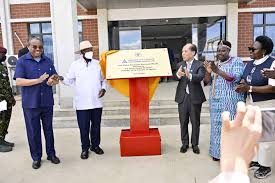
Ugandan President Yoweri Museveni has officially commissioned a massive cement raw material (clinker) production facility in the Moroto District of northeastern Uganda. Built at a cost of $300 million, the Yaobai Cement plant is expected to significantly reduce the country’s dependence on foreign imports for cement production materials.
The inauguration ceremony, held on Monday, was attended by high-ranking Ugandan government officials, Chinese diplomats, and former Ethiopian Prime Minister Hailemariam Desalegn, who currently serves as the Africa regional ambassador for West China Cement.
During his keynote address, President Museveni emphasized that clinker constitutes approximately 85% of the components required for cement production. He noted that Uganda has historically spent vast amounts of foreign currency to import this essential raw material, a drain on the economy that this new domestic facility is designed to eliminate.
According to company officials, once the plant reaches full operational capacity, it is estimated to save Uganda nearly $200 million annually in foreign exchange. This shift is expected to not only strengthen the national reserve but also lower domestic cement prices and stimulate the broader construction sector.
Located in the Nanduget area, the facility boasts a daily production capacity of 6,000 tonnes of clinker. Annually, the plant aims to produce 2 million tonnes of clinker and 3 million tonnes of finished cement. Beyond its industrial output, the project is a significant driver for local employment; Zang Jiewen, Chairman of West China Cement, confirmed that the factory will create more than 3,500 direct jobs. Furthermore, officials highlighted that the plant utilizes modern technology to adhere to low-emission standards, ensuring a sustainable industrial ecosystem for the region.
President Museveni also took the opportunity to highlight the dramatic transformation of the Karamoja region. He recalled that while Moroto was once characterized by conflict and instability, it has now evolved into a vital resource-rich industrial hub for the nation.
To sustain this momentum, the President pledged that his administration would provide a favorable tax regime and necessary infrastructure support to protect and encourage such large-scale investments.
The impact of the plant is expected to reach far beyond Uganda’s borders. The facility is strategically positioned to export its products to neighboring markets, specifically targeting South Sudan, western Kenya, and the Democratic Republic of Congo.
This regional expansion is anticipated to bolster Uganda’s trade standing within East Africa. Fan Xuecheng, the Charge d’Affaires at the Chinese Embassy, added that the partnership reflects the deepening economic ties between China and Uganda, while Vice President Jessica Alupo credited the country’s stable investment climate for making such milestones possible.