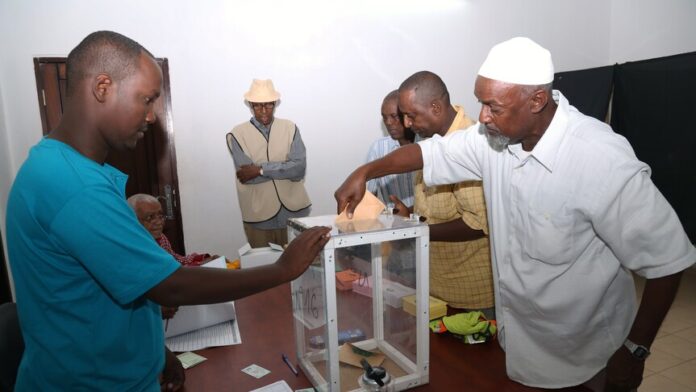
Djibouti votes Friday in a presidential election that could hand incumbent Ismail Omar Guelleh a sixth term, extending his 26-year rule over the strategic Horn of Africa nation.
Opposition candidate Mohamed Farah Samatar and his Unified Democratic Center (UDC) party pose little challenge to the ruling People’s Rally for Progress (RPP) , which has governed the country since its independence in 1977, independent observers say.
Last year, the parliament changed the Constitution, removing the age cap for candidates and allowing 78-year-old Guelleh to run again.
Speaking to supporters Wednesday at the final presidential campaign rally, Economy Minister Ilyas Moussa Dawaleh said “now” is the time for unity “to face these regional and international turbulences”.
Djibouti is a small but strategically vital country in the Horn of Africa, with a population of just over 1 million. It is dominated by Somali and Afar ethnic groups.
Its location at the Bab el-Mandeb Strait gives it immense geopolitical importance, as it controls access between the Red Sea and the Gulf of Aden, making it a key chokepoint for global oil shipments and commercial shipping between Europe and Asia.
“This strategic positioning explains its prominent role in the Horn of Africa and across the continent, including its current leadership position within the African Union,” said Abdurahman Sheikh Azhari, a regional expert.
However, he said, potential regional competitors that could challenge control over this chokepoint are institutionally fragile, including bordering Yemen and Somalia, both of which have been engulfed in prolonged civil conflicts.
“This creates a strategic vacuum that Djibouti is well-positioned to capitalize on,” he said.
However, this advantage also presents significant risks given ongoing regional tensions involving Iran, Israel, the US, and the Houthi movement, which could potentially disrupt or blockade the strait.
For decades, Djibouti has hosted major global powers, including France, the US, Japan and China.
Analysts believe this concentration of foreign military presence significantly limits external political interference in Djibouti’s domestic affairs.
Azhari, who also heads Wargelin Analytica, a think tank based in Somalia, said that countries maintaining military presence, such as the US, consider Djibouti a key strategic hub for securing the Red Sea and the Gulf of Aden, as well as for supporting counterterrorism operations across East Africa and the Horn of Africa.
“These states tend to avoid engaging in sensitive issues such as governance, democracy, and human rights in order to maintain strategic stability,” he said.
He noted that Western media coverage of Djibouti and its elections is generally limited to official government positions.
Djibouti has been a key contributor to African Union peacekeeping efforts and has deployed peacekeepers in neighboring Somalia.
Its troops are currently stationed in several regions, including Beledweyne, Buula-burte, and Jalalaqsi in Somalia’s Hiraan region of Hirshabelle state, to support the army in the fight against al-Shabaab.