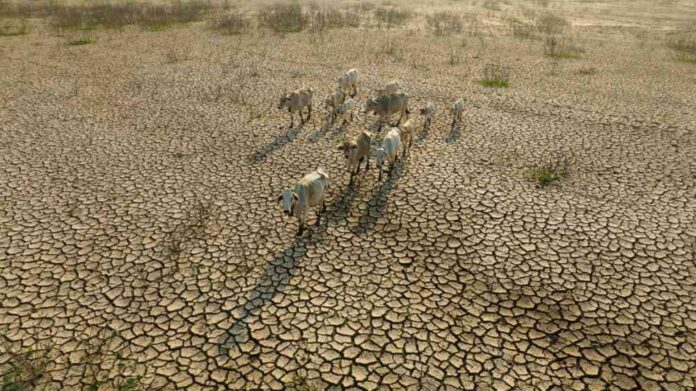
Drought has continued to grip East Africa at the start of 2026, pushing nearly 26 million into extreme hunger across Kenya, Somalia and Ethiopia, a recent Oxfam report found . But the crisis in the Horn of Africa runs far deeper than statistics.
In my community, the Agaw in northern Ethiopia, families have arrived from the lowland regions of Afar and Oromia. Repeated crop failures and livestock losses had forced them to leave the rock of stability they called home. Many are coming because our area has fared slightly better during the drought, with more reliable rains and pasture, offering a chance to rebuild livelihoods.
The drought, which began in about 2020 and is exacerbated by climate change, is an important driver of migration across the region. A 2023 appeal by the World Health Organization stated that 13.5 million people were internally displaced in the Greater Horn of Africa (Djibouti, Ethiopia, Kenya, Somalia, South Sudan, Sudan and Uganda). While 4.5 million were refugees abroad.
Better rains in 2024 offered some relief, but they also brought flooding in some areas. This made it harder to track the situation consistently. Figures for 2025 and 2026 are still being put together by the governments of Ethiopia, Somalia and Kenya, along with international groups like the UN and its agencies.
“Climate-induced migration is no longer a distant concern; it is a lived reality for millions of families in pastoral, agro-pastoral, rural and urban settings,” Mussa Mohammed, vice president of Jigjiga University in eastern Ethiopia, said at a recent conference on the issue.
His comments highlight a shift in how regional governments and institutions see the situation – not just as a crisis to respond to, but as a challenge that affects communities’ everyday lives. A challenge that requires careful planning and local solutions.
The complexity of climate impacts
As well as droughts, severe floods and environmental degradation are also driving people in East Africa to move, often without long-term planning or institutional support.
Participants at the Jigjiga conference highlighted how the environmental, political and social pressures that cause migration are often complexly intertwined. And how they affect people differently, depending on gender, ethnicity, class and other factors.
The conference was attended by government representatives and researchers from Ethiopia, Somalia, Djibouti, Kenya, South Sudan, Rwanda and Burundi. Speakers emphasised that addressing climate migration in East Africa requires transnational cooperation.
They also highlighted how climate stress, conflict and governance gaps interact to drive displacement. So-called “cascading” climate risks arise when a climate impact triggers second- and third-order effects. Heatwaves, droughts and water scarcity strain agriculture and livelihoods. While floods and sea-level rise endanger cities and infrastructure, which in turn impact health and political and economic stability.
Climate-related displacement does not affect all groups equally. Ifrah Ali Ahmed, senior advisor to Djibouti’s interior minister, drew attention to the challenges faced by young women and youth in Djibouti, including reduced access to healthcare, education, clean water and job opportunities. For young women especially, this can mean fewer resources and support systems and so more risk of exploitation.
Collective action is needed
Seid Mohamed, president of Jigjiga University, expressed the need for regional leadership rather than waiting for external solutions: “We are here to share evidence, solutions and a vision for a future where communities forced to move by climate change are supported, not neglected.”
That sentiment was echoed by government officials. Bashir Hussein Elmi, deputy head of the Disaster Risk Management Bureau in Ethiopia’s Somali region, described climate migration as a challenge with implications for security, development and social cohesion.
“We must anticipate movement, not react to it,” he said, calling for data-based policies and stronger cross-border cooperation. He emphasised the need for coordinated disaster-risk management, joint research and improved institutional preparedness as climate shocks intensify.
Integrating local knowledge
Responses must be locally grounded, speakers agreed. “Solutions imposed from outside risk being misaligned with our realities,” said Mekuria Argaw, executive director of the Horn of Africa Regional Environment Center and Network, and NGO. He added that the region already has deep reserves of traditional knowledge and scientific expertise.
Mohamed Omer from the Intergovernmental Authority on Development’s Climate Prediction and Applications Centre agrees. “Communities have long read the land and the seasons,” he said. “Policy must respect and integrate that wisdom.”
My own observations of communities show responses to climate and migration challenges work best when communities are actively involved in designing them, when they are built around local knowledge and existing relationships. In the Afar region of north-eastern Ethiopia, pastoralist families dealing with repeated droughts, livestock loss and shrinking grazing land were not simply moved elsewhere, but involved through clan elders in deciding where to go in search of water and pasture.
In the Somali region, where crop failures and displacement have pushed many households into difficult situations, women’s groups and young people have helped shape decisions about where to place water points and support services so they meet local needs. Along the Shabelle River, flood-prone communities have also played a key role in identifying danger zones and planning safer evacuation routes based on their lived experience.
Rather than relying only on distant technical solutions, effective approaches listen to local knowledge, respect existing coping strategies, and consider wider impacts. A key lesson is treating people as partners, not just recipients.
International support, regional action
International support is playing a role too. Funding from the European Union, through the International Centre for Migration Policy Development (ICMPD) and the Migration and Mobility Dialogue (MMD) Grant Facility, has supported research and capacity-building on migration and displacement in affected regions. ICMPD works with governments to improve how migration is understood and managed, strengthening policies, systems and cross-border cooperation. The MMD Grant Facility funds projects that explore migration dynamics and develop practical, locally grounded responses in areas facing complex pressures.
Argaw, from the Horn of Africa network, emphasised that external support is most effective when it reinforces, rather than replaces, local priorities and community-led solutions. “Financial backing must empower local decision-making. We are generating knowledge, informing policy, and building the structures needed to manage migration proactively.”
As Elmi, from the Disaster Risk Management Bureau, puts it, despite the challenges posed by climate-induced migration, “Eastern Africa will shape its future, with policies and partnerships that manage migration not as a crisis, but as a pathway to resilience.”