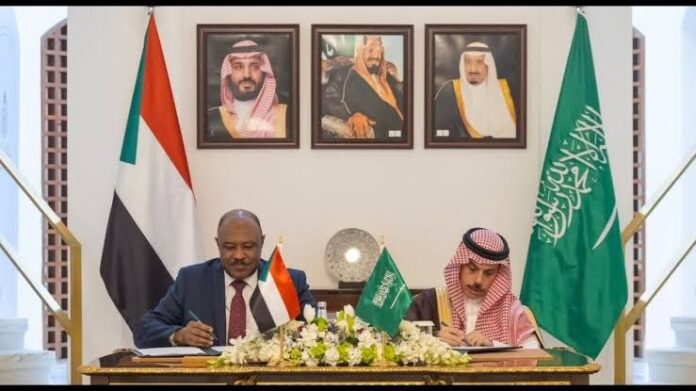
Sudan and Saudi Arabia have officially established the Supreme Council for Strategic Cooperation and Coordination. Formalized in Riyadh by Sudanese Foreign Minister Mohieddin Salem and his Saudi counterpart, Prince Faisal bin Farhan, this new framework is designed to elevate bilateral relations to unprecedented heights.
According to the countries’s state media, the council will oversee ten critical sectors, including economic development, investment, trade, and political affairs. By synchronizing the strategic visions of both governments, the council aims to streamline joint initiatives, foster sustainable economic growth, and deliver tangible results for both populations.
The roots of the partnership stretch back centuries, anchored by geographical proximity, shared religious heritage, and deep people-to-people connections centered around the holy cities of Mecca and Medina. Over the last decade, regional dynamics have accelerated this integration. A major turning point occurred in 2015 when Sudan aligned closely with Riyadh to counter regional security challenges, notably contributing approximately 10,000 troops to the Saudi-led coalition in Yemen and cutting diplomatic ties with Iran.
Economic collaboration has continually reinforced these political bonds. Even before the creation of the new council, Saudi investments in Sudan totaled roughly $11 billion, focusing heavily on agriculture to bolster regional food security using Sudan’s fertile lands.
Furthermore, economic ties continue to expand; in early 2026, Sudan’s Ministry of Mining signed a vital agreement with Saudi Arabia’s Global Mining Company to explore gold and mineral reserves in the Red Sea state. Politically, the council represents the realization of high-level discussions held in Mecca in March 2025 between Saudi Crown Prince Mohammed bin Salman and Sudan’s Sovereign Council Chairman, Abdel Fattah al-Burhan.
As Sudan navigates a complex internal transition and ongoing conflict following years of political upheaval, both Saudi Arabia and regional partners remain deeply engaged in its landscape. The new Supreme Council acts as a vital institutional anchor. By providing a structured, high-level platform for dialogue, it ensures that bilateral cooperation remains resilient despite immediate political crises.