Sudan has stated it remains open to diplomatic dialogue and political reconciliation with Ethiopia, provided Addis Ababa halts its alleged support for the paramilitary Rapid Support Forces (RSF) and ceases activities that threaten Sudan’s national security. The condition was highlighted during a diplomatic engagement in Khartoum as regional authorities expressed concern over cross-border dynamics exacerbating the ongoing civil conflict.
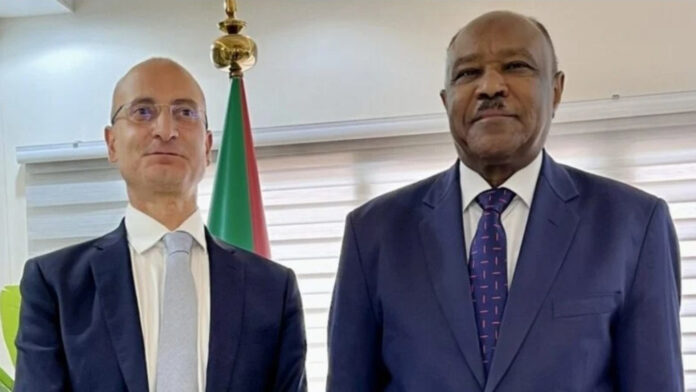
Speaking on Tuesday, October 13, 2026, Sudan’s Foreign Minister and Minister of International Cooperation, Ambassador Muhyiddin Salem, outlined Khartoum’s official stance during a bilateral meeting with Jean-Marie Safa, France’s Special Envoy for Sudan and the Horn of Africa. According to reports from Sudan’s state news agency, the discussion focused on bilateral relations, peace-building initiatives, and broad efforts to restore stability across the Horn of Africa.
“Sudan is a peace-loving country because it knows the hardships of war,” Foreign Minister Salem remarked during the conference, reiterating Khartoum’s willingness to re-engage constructively with Ethiopian authorities if specific security guarantees are met.
During the diplomatic session, Salem also called on France to re-evaluate its perspective on the Sudanese conflict based on verified ground realities rather than political narratives. The Foreign Minister firmly rejected allegations regarding the use of chemical weapons in the conflict and signaled that Sudan is progressing past a difficult period. In line with this stance, he formally urged Paris to consider reopening its diplomatic embassy in Khartoum and resuming operations at French cultural centers across the country.
In response, Special Envoy Safa emphasized France’s commitment to transparent relations with Sudan and expressed a willingness to support inclusive intra-Sudanese dialogue to help heal national political divisions.
The diplomatic exchange occurs against a backdrop of mounting accusations from Sudanese military officials concerning Ethiopian border areas, particularly within the Benishangul-Gumuz region. Khartoum alleges that border territories are being utilized to train RSF personnel and facilitate cross-border military incursions into Sudan’s Blue Nile State, specifically targeting the Kurmuk and Geissan districts.
Reports regarding RSF-linked training infrastructure in Benishangul-Gumuz initially surfaced in early 2026. Subsequently, investigative documentation released in April 2026 by the Yale School of Public Health’s Humanitarian Research Lab pointed to high-confidence evidence of military assistance activities near an Ethiopian National Defense Force (ENDF) facility in Asosa. Sudanese authorities have also raised concerns regarding drone staging operations and logistical support pipelines originating near the border.
Ethiopian officials have consistently rejected these claims, characterizing the accusations as unfounded and maintaining that Ethiopia adheres to strict principles of non-interference in neighbor state affairs. Furthermore, findings published by a United Nations fact-finding mission noted that while foreign fighters of Ethiopian nationality were identified among RSF-affiliated groups, there was no evidence demonstrating deployment, weapons supply, or financial support directed by the Ethiopian government.
The rift between Khartoum and Addis Ababa is further complicated by reciprocal accusations from the Ethiopian government. Authorities in Addis Ababa have accused Sudan of offering sanctuary and operational support to armed Ethiopian opposition factions, including the Tigray People’s Liberation Front (TPLF), the Oromo Liberation Army (OLA), and Amhara Fano militia groups.
The ongoing war in Sudan—which erupted in April 2023 due to a power struggle between General Abdel Fattah al-Burhan’s Sudanese Armed Forces (SAF) and Mohamed Hamdan Dagalo’s Rapid Support Forces—has displaced millions and disrupted regional political stability. Despite rising border rhetoric, Sudanese officials maintain that Khartoum does not seek open military conflict with Ethiopia, framing their demands as essential measures to secure border stability and foster durable regional peace.