As Somalia officially transitions from the ratification stage to active participation in the African Continental Free Trade Area (AfCFTA), the nation’s labor movement is demanding a prominent seat at the table. The Federation of Somali Trade Unions (FESTU) has called for robust labor protections and a formal, institutionalized role for workers in shaping the country’s single-market strategy.
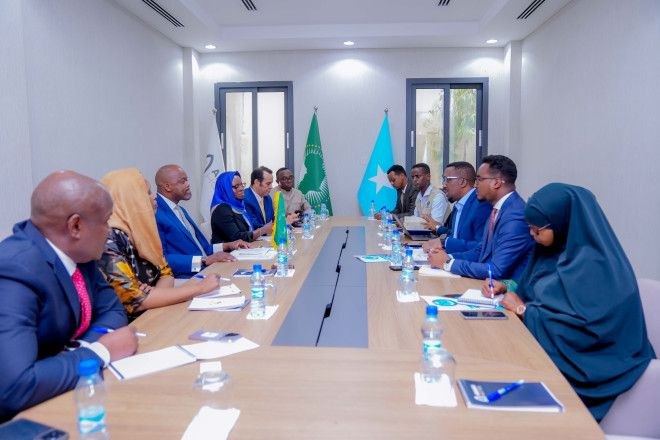
The demand was delivered during high-level talks in Mogadishu between AfCFTA General-Secretary Wamkele Mene and FESTU leadership, headed by Secretary-General Omar Faruk Osman. The meeting coincided with Mene’s landmark official visit to Somalia, marking a critical juncture as the nation prepares its domestic infrastructure and businesses to trade within a continental market spanning over 1.4 billion people.
While government officials and business leaders have largely championed the AfCFTA as a gateway for expanding exports, attracting foreign investment, and boosting trade volumes, FESTU argues that economic integration must go deeper. According to the federation, the primary measure of success should not simply be the flow of goods, but the creation of sustainable, decent jobs and the safeguarding of labor rights.
During the discussions, FESTU emphasized that working people form the literal engine of production, services, and economic activity. Consequently, the federation asserts that trade unions must be consulted from the earliest stages of policy formulation rather than being treated as an afterthought once major trade agreements have already been locked in.
Reflecting core positions promoted by the International Trade Union Confederation (ITUC) and ITUC-Africa, FESTU is pushing for permanent trade union representation and institutionalized social dialogue within all relevant AfCFTA governance structures.
“Workers are at the heart of production, services, and economic development,” Osman stated following the meeting. “As Somalia advances its participation in the AfCFTA, we want to see trade and investment creating decent jobs, protecting labour rights, and delivering real benefits to working people and their families, with trade unions having permanent and structured engagement with the AfCFTA.”
FESTU’s vision for Somalia under the continental trade agreement extends to a fundamental shift in the nation’s economic identity. Rather than participating in the single market predominantly as an importer and consumer of foreign goods, the federation argues that Somalia must leverage the opportunity to strengthen its domestic productive capacity.
This approach aligns with emerging government strategies aimed at boosting value addition, encouraging local manufacturing, and promoting goods under a “Made in Somalia” identity. Achieving this, however, will require targeted investments in productive sectors, workforce skills development, and rigorous enforcement of labor protections to ensure that expanded market access directly translates into tangible domestic economic opportunities.
AfCFTA General-Secretary Wamkele Mene welcomed FESTU’s proactive engagement and the broader involvement of organized labor. He cited the Somali federation’s active participation in implementation discussions as an exemplary model of social dialogue, reinforcing ongoing continental efforts to deepen cooperation with trade unions across Africa.
FESTU specifically credited the Minister of Commerce and Industry, Ambassador Gamal Mohamed Hassan, for fostering an inclusive, tripartite approach that bridges the gap between government, the private sector, and organized labor.