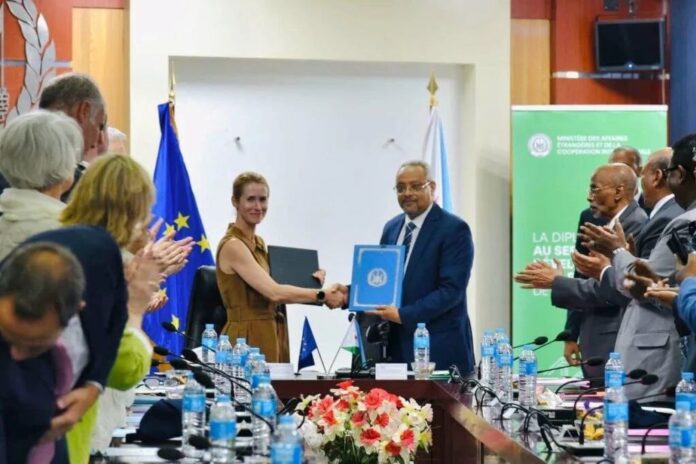
The Republic of Djibouti and the European Union have formally entered into a Status of Forces Agreement (SOFA). This accord serves as the definitive legal blueprint for the operations of the EU’s naval mission, EUNAVFOR ASPIDES, providing a secure, formalized base for the coalition’s activities within Djiboutian waters and territory. This signing signifies more than just a bureaucratic milestone; it represents a strategic pivot toward unified maritime defense against the mounting threats currently plaguing the Red Sea.
The formalization of this partnership coincided with a high-level diplomatic visit by Kaja Kallas, the EU’s High Representative for Foreign Affairs and Security Policy and Vice President of the European Commission.
During her sessions with Djibouti’s Minister of Foreign Affairs and International Cooperation, Abdoulkader Houssein Omar, and Acting Minister of Defense, Omar Abdi Saïd, the discourse moved beyond mere logistics. Representatives from both sides engaged in an in-depth assessment of the regional security landscape, reaffirming their shared mandate to act as guardians of international shipping lanes.
Launched in 2024 in response to the proliferation of attacks on commercial vessels, EUNAVFOR ASPIDES has become an essential component of maritime stability. By securing this SOFA, the EU has fortified the operational capabilities of this mission, ensuring that vessels transiting the Red Sea have a reliable, legally protected defense apparatus.
For Djibouti, hosting this mission underscores its status as a cornerstone of security in the Horn of Africa, further integrating the nation into global maritime security architectures.
Kallas’s mission was part of a larger, ambitious tour across the Horn of Africa, reflecting the European Union’s recognition that maritime security cannot be detached from regional land-based stability.
In Addis Ababa, she met with Prime Minister Abiy Ahmed and Foreign Minister Gedion Timothewos to discuss the intricate web of challenges affecting the continent.
The dialogues were wide-ranging, addressing the catastrophic humanitarian and security fallout from the war in Sudan, the enduring threat of Al-Shabaab in Somalia, and the destabilizing influence of external actors, including Iran’s regional posture.
Kallas also bridged the gap between European and African security interests, noting that the repercussions of Russia’s ongoing aggression against Ukraine are felt globally, further tightening the necessity for reliable partnerships like the one between the EU and Ethiopia.
Beyond the immediate security agenda, there was a palpable focus on economic development. Kallas emphasized that the EU’s commitment to the region is long-term, centered on a reciprocal relationship that promotes business opportunities and foreign investment. She articulated that the partnership between the EU and its regional allies is not merely a reactive measure against conflict, but a proactive strategy for prosperity.