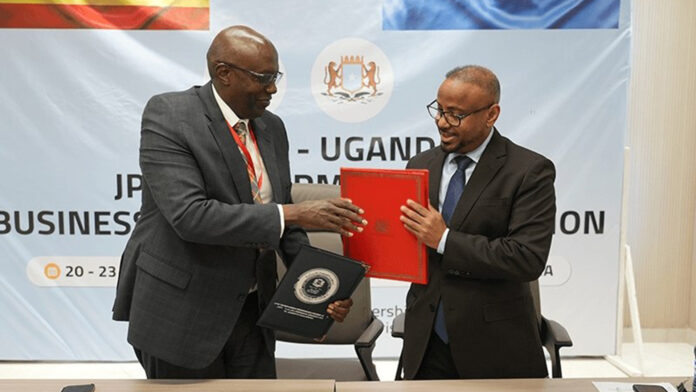
Somalia and Uganda have signed a bilateral labour agreement aimed at protecting workers’ rights and regulating employment, officials said on Thursday, marking a significant step in deepening cooperation between the two East African nations.
The agreement was signed by the two countries’ ministries responsible for labour during the Somalia-Uganda Joint Permanent Commission mid-term review, business forum and joint exhibition held in Mogadishu from 20 to 22 October.
Uganda’s Labour Minister Henry Tumukunde said the deal was intended to address challenges faced by some Ugandan workers in Somalia, including unpaid wages and employment benefits, the withholding of passports, employment without written contracts and disputes over work permits.
The labour pact comes amid growing numbers of Ugandan workers seeking employment opportunities in Somalia, where demand for skilled and semi-skilled labour has risen in recent years. Officials from both sides acknowledged that existing gaps in regulation had left some workers vulnerable to exploitation, prompting the need for a formal framework to govern employment conditions and protect migrants’ rights.
In civil aviation, the two governments agreed on a revised text of the Bilateral Air Services Agreement after identifying discrepancies in an earlier version. The revised document will undergo legal review, with signing scheduled for December 2026. The agreement is expected to improve air connectivity between the two countries and resolve outstanding issues affecting airline operations on both sides.
The two sides also agreed to sign an agreement on military training and education by 30 December 2026 and establish a joint defence committee. Somalia is expected to nominate its representatives to the committee by 30 October. The defence cooperation framework is seen as part of broader efforts to strengthen regional security ties and enhance capacity-building in Somalia’s security sector.
On economic cooperation, the countries agreed to finalise the establishment of a Joint Permanent Council on Investment and Trade by 30 November. Their investment promotion agencies will also hold regular meetings to assess progress in bilateral cooperation. The council is expected to serve as a platform for addressing trade barriers, promoting cross-border investment and facilitating business-to-business linkages between the two countries.
Other planned agreements cover health, statistics, customs and product standards, with deadlines established for their completion. Officials said these sectoral agreements would help harmonise standards and streamline procedures for goods and services traded between the two nations.
The agreed minutes also indicate that some previous commitments remain unfulfilled, including planned business meetings and unresolved challenges affecting Uganda Airlines’ operations in Somalia. Both delegations acknowledged the need to address these outstanding issues and agreed to track progress more closely going forward.
The meeting followed the second session of the Joint Permanent Commission held in Kampala on 7-8 October 2025, where the two governments agreed to conduct annual reviews of progress on bilateral commitments.
The delegations were led by the permanent secretaries of their respective foreign ministries, Hamza Adan Haadow of Somalia and Vincent Bagiire Waiswa of Uganda. Somalia’s Minister of Foreign Affairs and International Cooperation, Abdisalam Abdi Ali, formally opened the Mogadishu meeting.
Both sides agreed to continue conducting annual reviews of their bilateral agreements and commitments. The third session of the Somalia-Uganda Joint Permanent Commission is scheduled to take place in Somalia in 2027, with the exact date to be determined by the two governments.