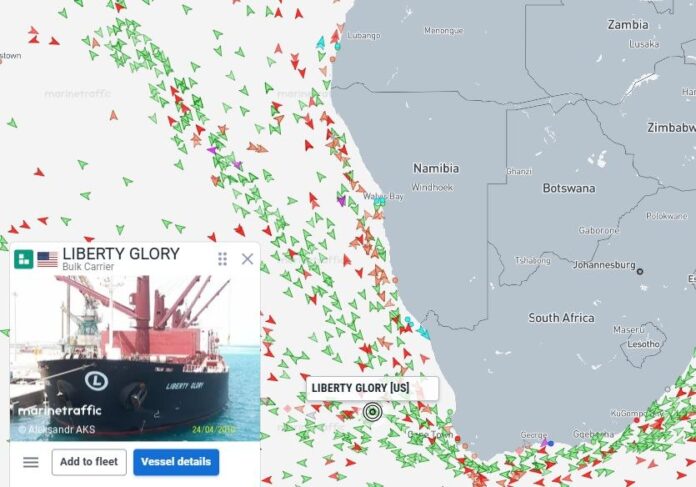
The U.S.-flagged bulk carrier Liberty Glory is currently navigating the final leg of its journey across the Indian Ocean, carrying 47,000 metric tons of essential U.S.-grown agricultural commodities. The vessel, which is carrying life-saving food aid for millions, departed the Port of Houston, Texas, in mid-June 2026 and is expected to arrive at the port of Berbera by July 18, 2026, after a 38-day voyage.
The ship is loaded with 37,700 metric tons of sorghum and 9,200 metric tons of hard red winter wheat, sourced directly from American farmers. These supplies are part of the U.S. government’s “Food for Peace” program, a cornerstone of American humanitarian diplomacy.
The arrival of the Liberty Glory comes at a critical juncture for Ethiopia, where humanitarian needs remain alarmingly high. The Famine Early Warning Systems Network (FEWS NET) projects that by July 2026, between 15.0 and 15.9 million people in Ethiopia—roughly 10–15 percent of the national population—will face Crisis (IPC Phase 3) or Emergency (IPC Phase 4) levels of acute food insecurity.
This crisis is driven by a convergence of factors, including the lingering effects of regional conflicts, widespread displacement, and climate-related stressors like drought exacerbated by the ongoing El Niño, which has stalled the vital kiremt rains.
The U.S. Department of Agriculture (USDA) recently announced an agreement in principle with Catholic Relief Services (CRS) to provide up to $235 million in emergency food and nutrition assistance for Ethiopia and Sudan. This broader initiative is expected to mobilize more than 110,000 metric tons of U.S.-grown agricultural commodities to assist millions of people suffering from severe malnutrition.
Following significant legislative shifts in Washington, the administration of the “Food for Peace” program has undergone a historic transition. As outlined in the Farm, Food, and National Security Act of 2026, the authority for administering the program has been permanently transferred from the U.S. Agency for International Development (USAID) to the U.S. Department of Agriculture (USDA).
This legislative change, referred to as “Farm Bill 2.0,” reflects a strategy to integrate international aid more closely with U.S. agricultural interests. The legislation passed the U.S. House of Representatives by a vote of 224–200. Proponents, such as Representative Tracey Mann, argue that the move “prioritizes American-grown commodities and increases the accountability of taxpayer dollars,” effectively returning the program to its “rightful home.”
Under the USDA’s “Farmers First” strategy, all commodities distributed through these programs will be of 100 percent U.S. origin, securing domestic supply chains and ensuring that American farmers remain the backbone of global emergency response.
While the arrival of the Liberty Glory is welcomed by humanitarian organizations, it has also sparked renewed domestic discourse within Ethiopia regarding food self-sufficiency.
Despite government programs aimed at boosting domestic wheat production, persistent reliance on international humanitarian grain shipments remains a focal point of public and political debate. Critics argue that such aid, while necessary, can undermine local farming by flooding the market with subsidized imports, depressing crop prices, and discouraging investment in domestic agriculture.