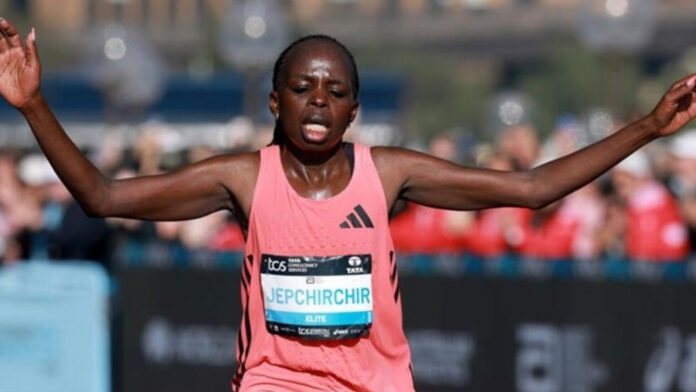
Kenya’s athletics community has been left reeling after news emerged that Olympic marathon champion Peres Jepchirchir has been provisionally suspended following a positive test for a banned substance, casting a shadow over the East African nation just as it prepares to host the 2029 World Athletics Championships in Nairobi.
The highly decorated 33-year-old Kenyan, who won Olympic gold at the Covid-delayed Tokyo Games in 2021, was suspended after an out-of-competition sample tested positive for the banned blood booster EPO (erythropoietin). The Athletics Integrity Unit (AIU) confirmed that the sample was collected in Kenya prior to her recent victory at the Sydney Marathon. Under anti-doping rules, an athlete is provisionally suspended while their case is investigated.
Jepchirchir’s suspension adds her name to a growing list of more than 140 Kenyan athletes, including current women’s marathon world record-holder Ruth Chepngetich, who have been suspended or banned by the AIU since 2017. The news comes at a particularly sensitive moment for Kenyan athletics, following World Athletics’ decision to award Nairobi the 2029 world championships — a decision likely to increase scrutiny of the country’s anti-doping policies.
Barnabas Korir, Athletics Kenya Youth Development Director and National Olympic Committee of Kenya vice president, expressed his disbelief at the news. “It’s a big disappointment coming soon after we were awarded the World Athletics Championship in 2029,” Korir told AFP. “We are in shock, especially in the calibre of Peres Jepchirchir after a stellar career. We don’t know what is happening with our athletes.”
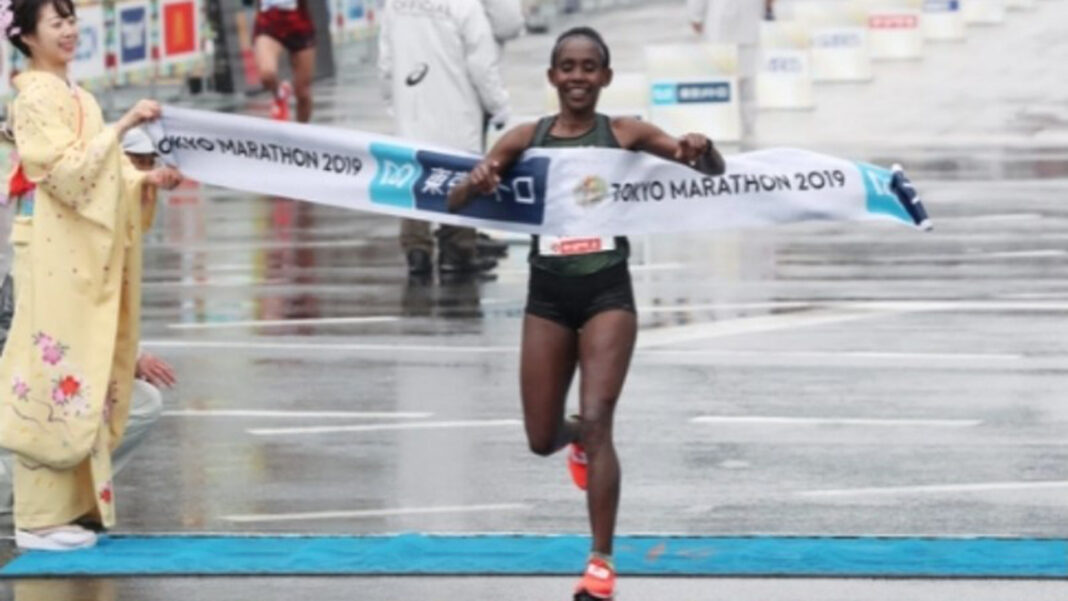
Jepchirchir’s career has been nothing short of illustrious. A former world record-holder in the half-marathon, she is a four-time World Marathon Major winner, having captured the Sydney Marathon (2026), the London Marathon (2024), the Boston Marathon (2022) and the New York Marathon (2021). Her Olympic triumph in Tokyo cemented her status as one of Kenya’s finest distance runners.
The timing of the suspension is especially damaging given recent warnings from the World Anti-Doping Agency (WADA). Earlier this month, Kenya hosted a three-day visit from WADA, during which the body’s chief, Witold Banka, urged the country to strive for zero tolerance on doping. “Kenya proudly calls itself the Home of Champions. But for that home to remain respected and credible, it must also be clean,” Banka said. “That is why Kenya needs a strong culture of clean sport, zero tolerance for doping, and a more determined approach to preventing and fighting doping.”
Banka emphasised that cooperation with Kenyan authorities would be essential to laying the foundations for a cleaner sport. “WADA or ADAK (Anti-Doping Agency of Kenya) alone cannot achieve its vision if we do not cooperate with those who have the power to go against those who are producing, smuggling and trafficking dangerous steroids to your athletes,” he said. “We’ve found a common understanding and we are on the same track and there’s a clear goal within Kenya for zero tolerance for doping policy and it has to be established immediately with joint actions and a more aggressive approach to those who are destroying the image of the country and the reputation of the athletes.”