
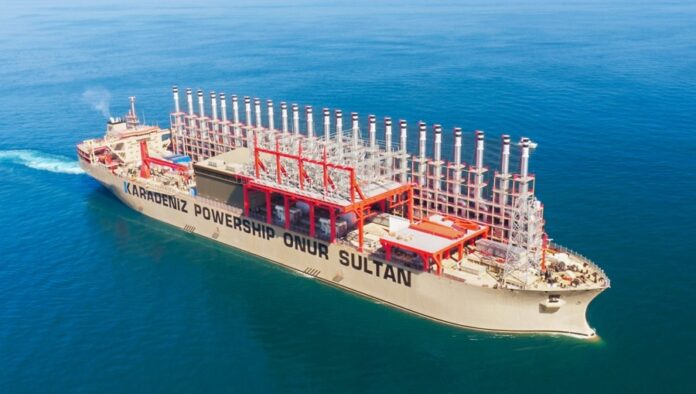
In a bid to curb the recurring power outages that are driving the country toward a severe economic crisis, the Kenyan government has begun exploring a novel, alternative solution. To plug the growing electricity gap that has left millions of households and businesses reeling, the government is reportedly in early talks with “Karpowership,” an Istanbul-based Turkish company that operates floating power plants mounted on ships.
Technical and commercial discussions are underway with the renowned Turkish firm to provide an urgent electricity supply to coastal towns and commercial hubs along Kenya’s coastline.
According to Joseph Siror, the Managing Director of the Kenya Power and Lighting Company (KPLC), negotiations with the Turkish firm began in 2024, but the process has now reached an advanced stage. Emerging reports indicate that the project is expected to be fully operational by December of this year, 2026.
The root cause of Kenya’s current power deficit is widely attributed to a government moratorium introduced seven years ago. In 2018, the Kenyan government froze new Power-Purchase Agreements (PPAs) with independent power producers. However, during the years this freeze remained in place, national electricity demand continued to climb at a rapid pace.
Data shows that while the country’s peak power demand stood at 1.8 gigawatts (GW) in 2018, it surged by a third to reach a record high of 2.4 gigawatts by 2025. Although the government finally lifted the moratorium in November last year, the structural damage remains highly visible. Highlighting this stress, Kenya’s electricity imports hit a record 11 percent of overall national consumption in 2025—a clear sign that the national grid was struggling to keep pace with demand.
Currently, the Kenyan national grid operates on a razor-thin reserve margin of just 2.3 percent. The country’s firm operational capacity hovers around 2,495 megawatts (MW), while peak system demand has reached roughly 2,439 MW. This means there is virtually no spare capacity to stabilize the grid in the event of an unexpected technical fault. Consequently, Kenya Power has been forced to implement planned evening load-shedding to preserve overall grid stability and prevent total blackouts.
To address this critical deficit, the government has turned to Turkey’s Karpowership, which boasts a fleet of 45 modern vessels worldwide. Together, these ships are capable of generating more than 8,000 megawatts of power and currently supply electricity to over 20 countries across Africa, Europe, South America, and Asia.
The primary benefit of this technology is its “plug-and-play” nature. Once the vessels are anchored at a port and connected directly to the national grid, they can deploy and begin commissioning power in under 30 days. This rapid turnaround makes it an highly attractive option for countries in urgent need of supply, like Kenya.
Energy analysts at Bloomberg note that surging demand in Kenya has made new supply options an absolute necessity, reinforcing the government’s exploration of unconventional options like floating power plants. While a floating power plant is not viewed as a permanent fix, it serves as an ideal stopgap measure to stabilize the national grid while longer-term generation projects—such as geothermal and hydroelectric facilities—are being developed and finalized.