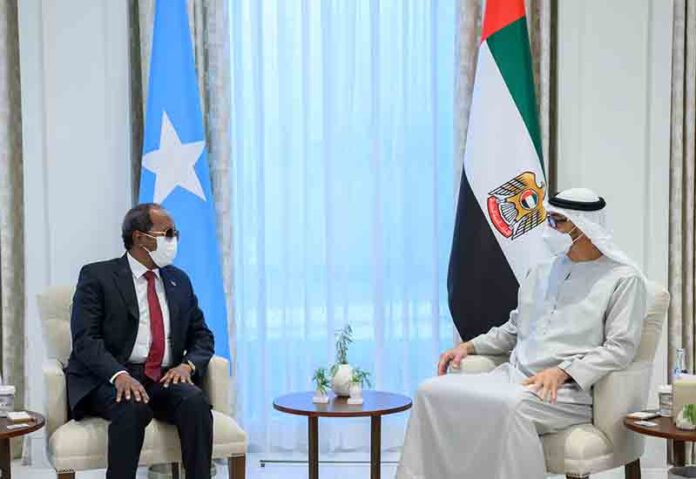
Geopolitical tensions in the Horn of Africa have resurfaced following the United Arab Emirates (UAE) government’s official reception and hosting of Somaliland President Abdirahman Mohammed Abdullahi Irro and his high-level delegation in Dubai. Reports indicate that the high-level state protocol extended to President Irro during his stay in Dubai, including his accommodation in a special government guest house, demonstrates the diplomatic and strategic value Abu Dhabi places on Hargeisa.
This visit has drawn international attention as it comes at a time when relations between Abu Dhabi and the Federal Government of Somalia (Mogadishu) are severely strained. While Mogadishu has been voicing strong opposition, accusing the UAE of violating Somali sovereignty, the hosting of the Somaliland leader in the Emirates is expected to further strengthen the “operational diplomacy” between the two sides.
The primary focus of the discussions between President Irro and UAE officials is reported to be on trade, investment, and infrastructure development. Most notably, the $442 million investment made by the international logistics company DP World in Somaliland’s Port of Berbera serves as the backbone of this connection.
Although the Federal Government of Somalia has declared all security and port agreements with the Emirates “null and void,” DP World has officially announced that it will continue its operations at the Port of Berbera.
The company’s recent opening of a new maritime corridor between Dubai’s Jebel Ali Port and Berbera indicates an intent to transform the area into a hub for regional trade. During his stay, President Irro visited the ‘Deira Al Hamra’ port terminal in Dubai—a key entry and exit point for Somaliland trade—aiming to boost future cooperation in agriculture, renewable energy, and aviation.
The close relationship between the UAE and Somaliland has been difficult for Mogadishu’s leaders to accept. In a decision passed on January 12, 2026, the Somali Cabinet announced the termination of all bilateral agreements with Abu Dhabi. Mogadishu cited “the UAE’s involvement in activities that harm Somalia’s national unity” as the reason for this decision, claiming to possess “strong evidence” to support its stance.
The regional political alignment shifted significantly after December 26, 2025, when Israel became the first UN member state to recognize Somaliland as a sovereign nation. Although the UAE officially opposed the Israeli recognition during an Arab League meeting, Somali officials suspect that the Emirates’ long-term economic and political interests in Somaliland involve deeper motives.
The UAE’s policy toward the Horn of Africa prioritizes “practicality” over formal diplomatic recognition. Although Somaliland has governed itself independently for the past three decades without international recognition, Abu Dhabi is effectively strengthening its ties as if it were a sovereign state, even if it stops short of “official recognition.”
This type of relationship represents a major political victory for Somaliland. President Irro’s visit allows the country to expand its connections with international partners and raise its diplomatic profile. Conversely, the UAE is said to view Somaliland as a key partner in maintaining its strategic influence in the Horn of Africa and ensuring the security of the Red Sea.