A new military conflict engulfing the Middle East since late February is reverberating far beyond the region—raising energy and food costs, rattling financial markets, and testing the resilience of economies across the globe. For sub-Saharan Africa, where budgets are already tight and many households remain highly exposed to food and fuel prices, the latest shock carries a particular risk: even modest changes in global conditions can translate into larger, slower growth at home.
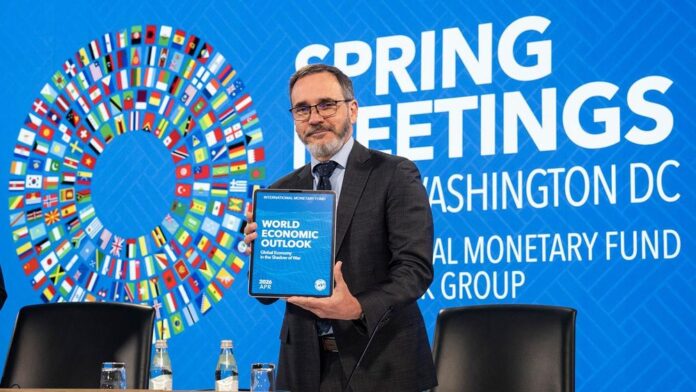
According to the IMF’s World Economic Outlook (April 2026), the conflict is worsening an already uncertain global environment through higher commodity prices and second-order effects on inflation expectations—mechanisms that can be especially sensitive to energy and food prices. In practical terms, that means import-dependent countries in sub-Saharan Africa face the prospect of sharper currency depreciation and higher import bills, which can quickly strain inflation control and public finances.
Sub-Saharan Africa’s Growth Holds—But Costs Are Rising
On aggregate, sub-Saharan Africa’s growth outlook remains relatively stable in the IMF’s reference forecast, projected at 4.3% in 2026 and 4.4% in 2027. But the figures mask important variation across countries—particularly between oil exporters and oil-importing, non-resource-intensive economies.
The IMF also highlights that the conflict’s impact is likely uneven across the region. Some large economies continue to benefit from earlier macroeconomic stabilization and reform efforts. Others, however, are expected to feel pressure through weaker trade links, higher operating costs, and disruptions that compound domestic vulnerabilities.
For example:
- Nigeria is projected to maintain momentum, with growth around 4.1% in 2026 and strengthening to 4.3% in 2027, supported by improved macroeconomic stability and favorable terms-of-trade effects—though goods and transport costs remain headwinds.
- South Africa is projected to slow more noticeably, with growth expected around 1.0% in 2026, then a partial recovery to 1.3% in 2027, as disruptions related to the conflict subside.
- Across the broader region excluding these standout dynamics, the IMF notes revisions to the outlook that point to weaker performance than previously expected.
Commodity Prices and Currency Risk: The Fast-Acting Transmission Channels
Where the conflict becomes most dangerous for sub-Saharan Africa is not necessarily through direct geopolitical exposure—it is through prices and financial conditions.
The IMF projects that in a key downside framing, the conflict could lead to material increases in oil and gas prices and also push up food commodity prices. Higher energy prices feed into:
- transportation and logistics costs,
- electricity generation and industrial input prices,
- and the price of fertilizers (a critical pathway into food production costs).
Meanwhile, if energy and food imports become more expensive, currency depreciation can amplify the cost shock. That is crucial for economies that borrow in foreign currency or rely on imported staples to stabilize food supply.
In its assessment of downside scenarios, the IMF emphasizes that emerging and developing economies can be hit harder than advanced economies—not only because of commodity exposure, but also due to tighter financial conditions and higher risk premiums when markets “go risk-off.”
The Fiscal Tightrope: Protecting Households Without Losing Policy Space
With inflation pressures rising, governments face a difficult policy trade-off. The IMF argues that countries need to preserve price and financial stability while also protecting vulnerable households—without permanently damaging fiscal sustainability.
That tension is especially acute in many sub-Saharan economies where:
- debt burdens are high,
- reserves are limited,
- and reform or social spending needs compete for room in national budgets.
The IMF warns against broad, discretionary subsidies or untargeted price controls in response to cost-of-living pressures, noting that such measures are often regressive, expensive, and politically hard to roll back. Instead, where support is unavoidable, the emphasis is on timely, explicit, and tightly targeted transfers—with clear sunset clauses and identified offsets.
A Riskier World for Finance: When Confidence Erodes, Borrowing Costs Follow
Beyond commodity prices, the IMF’s broader risk analysis points to another threat: capital flow reversals and abrupt asset repricing tied to heightened geopolitical uncertainty. In this environment, investors may demand higher returns, driving up sovereign spreads and corporate borrowing costs.
For sub-Saharan Africa, the consequences can include:
- higher interest costs on new and rolling debt,
- reduced availability of trade finance,
- and slower private investment.
The IMF specifically notes that a stronger “risk-off” environment tends to tighten financial conditions more strongly in emerging markets excluding China—and that the amplification can extend through inflation expectations.
Two-Speed Impacts: Oil Exporters vs. Import-Dependent Economies
Sub-Saharan Africa’s exposure is shaped by whether economies are net energy exporters or net energy importers.
- Oil exporters may benefit in the short run from improved terms of trade, though they can still suffer if conflict disrupts shipping routes, damages energy infrastructure, or raises global financing costs.
- Oil-importing economies face a more direct and immediate challenge: higher import bills for fuel and inputs, which can quickly spill into inflation and domestic demand.
This is why even if the region’s aggregate growth number looks resilient, policymakers may still face serious pressure in specific sectors—especially food supply chains, transport, power, and manufacturing with import-dependent inputs.
What Comes Next: Preparing for a Longer Conflict and a Volatile Commodity Backdrop
The IMF stresses that the ultimate global impact depends on the conflict’s duration, intensity, and scope—variables that remain unpredictable.
For sub-Saharan Africa, the policy challenge is to be ready for multiple paths:
- a shorter conflict that allows commodity prices to normalize,
- a prolonged conflict that keeps energy and food costs elevated,
- and a market reaction that tightens global financial conditions further.
To manage that uncertainty, the IMF underscores the value of:
- credible monetary policy communication,
- safeguarding central bank independence,
- maintaining a flexible but orderly exchange rate where feasible,
- strengthening prudential oversight,
- and preserving fiscal credibility and debt sustainability.
Bottom Line
Sub-Saharan Africa’s growth outlook is not collapsing—but it is increasingly operating under a “shadow of war” economy: one where external shocks translate into higher costs, tighter financial conditions, and sharper fiscal constraints. The region’s resilience may hold in aggregate forecasts, but for households and firms—especially in oil-importing and debt-vulnerable economies—the new shock could still mean slower improvement, rising hardship, and a narrower margin for policy error.