
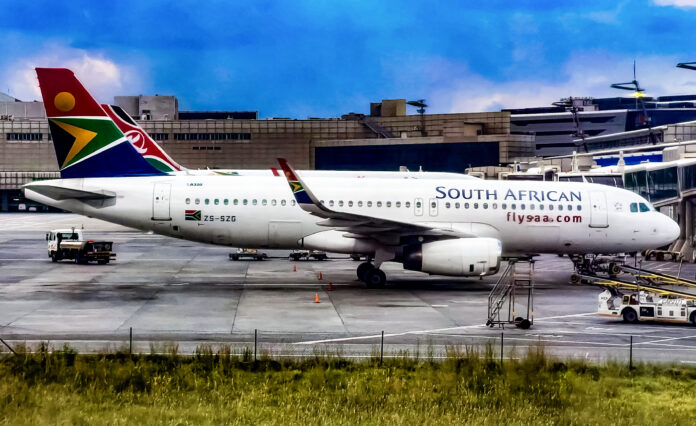
African countries are positioning for a new class of aviation-linked carbon credits, adding a regulated layer to what has largely been a voluntary market.
A recent supply agreement involving Econetix, linked to a project in the Democratic Republic of Congo and structured with SCB Environmental Markets as a distribution partner, highlights how African carbon credits are increasingly being developed for aviation compliance markets under the Carbon Offsetting and Reduction Scheme for International Aviation (CORSIA).
On March 5, 2026, Econetix, a global carbon asset manager, received a Letter of Authorization (LoA) from the DRC for 750,000 tCO₂e (equivalent tons of carbon dioxide emissions) across two Gold Standard-certified projects, GS12620 (Improved Cookstoves) and GS12470 (Solar Lamps). SCB Environmental Markets is acting as a distribution partner.
According to Jakob Zenz, CEO and Founder of Econetix, “750,000 tonnes from the DRC is the first major step, with Uganda, Tanzania, Malawi, and Sierra Leone to follow shortly.”
While the deal itself does not constitute a direct off-take with airlines, it demonstrates how African credits are being structured to meet CORSIA compliance requirements. The deal reflects a broader shift toward credits that meet stricter international standards, particularly where eligibility, traceability, and host-country approval are becoming central.
“There is no doubt Africa’s carbon market is at a pivotal moment,” said Maria Maina, carbon markets specialist at the African Climate Institute. “Regional coordination through alliances, combined with rigorous standards like CORSIA, is creating a credible pathway for revenue while supporting social and environmental goals.”
Aviation is rapidly changing how carbon markets function globally, turning what was once a largely voluntary system into a compliance-driven market with defined rules, buyers, and pricing signals. Governments across Africa are tightening regulations, building registries, and asserting control over the generation and sale of carbon credits.
CORSIA, introduced by the International Civil Aviation Organization (ICAO), drives this transformation by capping emissions from international flights. Under CORSIA, airlines must offset emissions growth using approved carbon credits, creating a structured global market tied directly to aviation emissions.
The CORSIA system began its pilot phase in 2021, entered its first compliance cycle in 2024, and is now moving toward stricter enforcement. More than 120 countries have signed on, with additional states expected to join as full compliance obligations expand through 2026, according to ICAO.
As international travel recovers and expands, emissions are rising, increasing the volume of offsets required under CORSIA. Supply, however, remains constrained. Only a limited number of projects globally can produce CORSIA-eligible credits.
Historically, project-driven carbon markets dominated Africa, with limited oversight from governments. Revenues often flowed outward, and national control over issuance and transfer was weak. That model is now changing.
In March 2026, representatives from Botswana, Lesotho, Madagascar, Malawi, Mauritius, Mozambique, Zambia, and Zimbabwe officially launched the Southern Africa Alliance on Carbon Markets and Climate Finance in Victoria Falls, Zimbabwe.
The Alliance aims to coordinate regional carbon market strategies, strengthen regulatory frameworks, and enable African countries to participate more effectively in global carbon markets under Article 6 of the Paris Agreement.
The Alliance will work closely with private sector actors, development partners, and other African regional alliances to harmonize regulations, share knowledge, and strengthen institutional foundations.
Malawi, in November 2025, operationalized carbon credit issuance aligned with international compliance standards, becoming one of Africa’s earliest movers in aviation-linked carbon projects. Gold Standard labelled more than 1.5 million credits from Hestian’s GS11677 Biomass Energy Conservation Program as eligible for CORSIA Phase One.
The project distributes locally manufactured, energy-efficient cookstoves to rural households, reducing emissions while delivering social benefits, including improved health and increased participation of women and children in education and work.
Tanzania has also adopted a regulatory-led approach, expanding frameworks for approving and exporting credits. The Environmental Management (Control and Management of Carbon Trading) Regulations, which were first released in 2022 and updated in 2023, require projects to follow national policies, help meet Nationally Determined Contributions, and get Letters of Approval for international transfers under Article 6.
Kenya launched the Kenya National Carbon Registry (KNCR) in February 2026, developed by the National Environment Management Authority (NEMA) with Verst Carbon. The registry is intended to underpin Article 6 participation, ensure transparency, and integrate project pipelines into international compliance markets.
“The gap between supply and demand for CORSIA credits makes early compliance-ready projects in Africa highly valuable,” explains Zenz.
Beyond these national efforts, the private sector is also scaling regulatory efforts. Carbon developer DelAgua has announced that over 4.7 million of its credits from Rwanda, Sierra Leone, and The Gambia are now eligible for Phase 1 of CORSIA.
The company secured LoAs from host governments and worked with Verra to tag the credits, providing airlines with confidence in compliance eligibility.
A further 3 million credits are expected in Q2 2026, highlighting growing supply. However, not all projects have navigated regulatory hurdles. KOKO Networks, a Kenyan clean cooking company that had generated around 6 million Gold Standard credits annually, recently shut down after failing to secure a LoA from the Kenyan government. The closure illustrates the challenges developers face in aligning with host-country regulations while participating in global aviation compliance markets.
Analysis from ICAO’s 2025 review of CORSIA’s pilot phase shows that sustainable aviation fuels will cover only 6–10% of offsets during Phase One (2024–2026), leaving carbon credits to shoulder the majority. Market analysts project prices could exceed US$60 per tonne after 2030, up from US$21 in late 2025, signalling a major revenue opportunity for African nations.