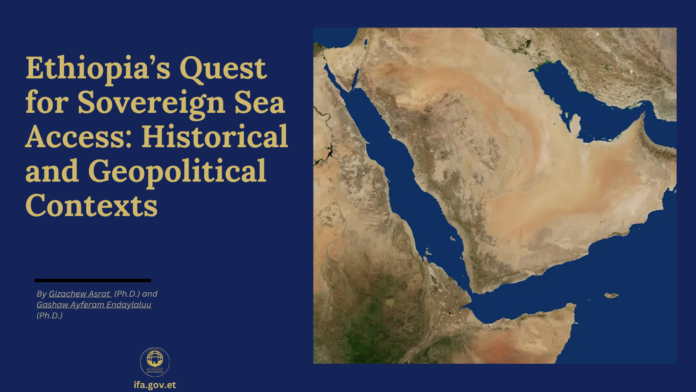
Prime Minister Abiy Ahmed has reaffirmed Ethiopia’s strategic interest in securing access to a sea outlet. The Prime Minister explained that Ethiopia’s status as a landlocked nation is not only a major bottleneck for its economic growth but also a significant obstacle to the long-term regional stability of the Horn of Africa.
In an interview with the national TV the Ethiopian Broadcasting Corporation, Prime Minister Abiy stated that lasting peace cannot prevail in the Horn of Africa as long as Ethiopia lacks direct access to the sea. He pointed out that for a country whose population increases by millions every year, the absence of its own sovereign port is considered a major “existential threat.
“The Prime Minister remarked, “A nation with such a large population remaining landlocked prevents it from standing fully independent in international trade competition,” adding that this situation also poses a threat to the country’s national security.
The leader’s remarks once again signal Ethiopia’s interest regarding the Port of Assab in neighboring Eritrea. It is recalled that Assab served as Ethiopia’s primary trade gateway prior to the 1998-2000 border war.
Describing the search for a sea outlet as a matter of national destiny, the Prime Minister emphasized that Ethiopia cannot sustainably continue being isolated from international maritime routes. While this pursuit of sea access has sparked intense regional diplomatic discussions—following the recent Memorandum of Understanding signed with Somaliland—the Prime Minister indicated a continued readiness to resolve the matter through dialogue.
Although Ethiopia has invested heavily in infrastructure such as the Ethio-Djibouti railway, modern highways, and dry ports to overcome its geographical isolation, it was noted that these developments cannot replace the necessity of a sovereign sea outlet. The country’s rising logistics costs and the substantial foreign currency spent on port rentals continue to exert heavy pressure on the economy.
Economic experts suggest that securing its own sea outlet would not only free Ethiopia from port lease expenses but also create significant capacity for exports, enabling the country to supply industrial products to the global market at a lower cost.
The Prime Minister indicated that the question of a sea outlet is a foundation for the collective prosperity of the entire Horn of Africa, not just Ethiopia. He called for the establishment of a regional framework that ensures Ethiopia’s economic interests while fostering close integration with neighboring countries.