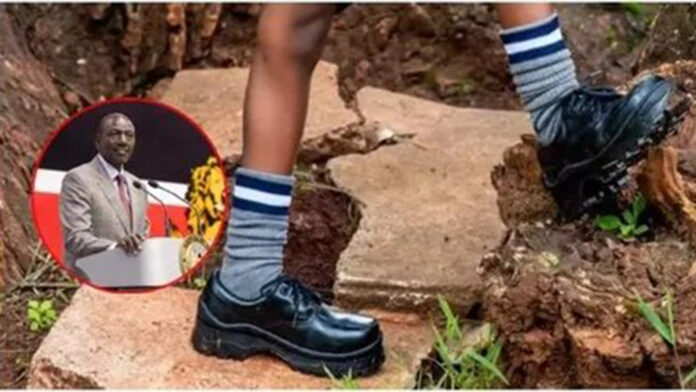
President William Ruto has announced an ambitious plan to have local manufacturers produce leather shoes for all 14 million school-going children in Kenya, in a move aimed at boosting the country’s leather industry through guaranteed local demand.
Speaking during the Innovation Summit at the Kenyatta International Convention Centre (KICC) on Wednesday, November 4, the President said the government now wants local footwear makers to step up and supply schools nationwide.
“We will now move a step further. We want you to manufacture all the shoes for our school-going children, and we have 14 million of them,” President Ruto stated.
He spoke about the plan while outlining his broader push to grow Kenya’s leather industry and create jobs for the youth.
To make the plan work, Ruto explained that the government is bringing manufacturing closer to the people rather than concentrating everything in Nairobi. He added that the intention is to devolve the entire manufacturing ecosystem so that every county gets a share of the opportunities.
To reinforce the move, a Ksh5.8 billion investment is already supporting the Kenya Leather Industrial Park in Kenani, Machakos, which was unveiled on September 2 by Deputy President Kithure Kindiki. The facility features modern equipment for processing and manufacturing leather products.
The directive follows an earlier move in June, when the President issued a strict order that security agencies buy boots made in Kenya. By October, he confirmed during a town hall at Jamhuri Park that military and police boots were fully made locally, and he banned their importation.
He now wants the same approach applied to schools, saying the 14 million learners represent a huge market for local shoe makers.
At the moment, Kenya ranks 11th globally in livestock herd size, with approximately 80 million animals. The country also has Africa’s third-largest livestock population, according to the World Bank and the Kenya Leather Development Council.
Despite its livestock numbers, Kenya ranks 87th among 208 countries in leather apparel exports, valued at Ksh68 million (USD527,000), and 101st among 223 importers, spending Ksh285 million (USD2.2 million). In Africa, Kenya ranks third in livestock production and 11th globally — a standing that President Ruto is banking on to turn the sector around.
The announcement was made on a busy news day that also saw Deputy President Rigathi Gachagua withdraw a High Court case challenging his impeachment, and the Supreme Court rule on the eviction of Kenyans living on public land without title deeds. Other developments included a warning by the Kenya Medical Practitioners and Dentists Union (KMPDU) of doctors’ strikes in 17 counties from November 25, and the Universities Academic Staff Union (UASU) issuing new demands over a Ksh20 billion deal following a nationwide strike.
The President’s latest directive is expected to spark fresh debate on the capacity of local manufacturers to meet the huge demand, the quality standards required for school footwear, and how the government will enforce the policy across public and private schools. It