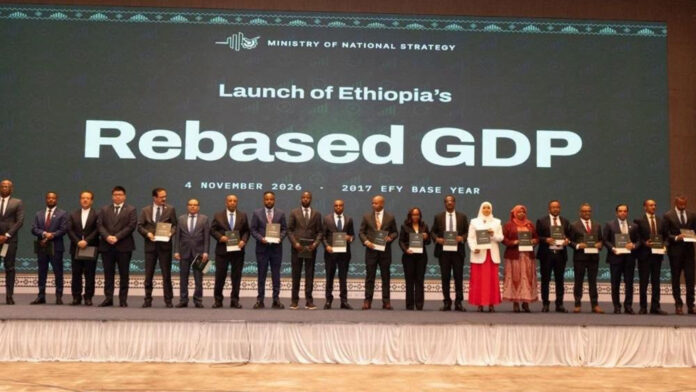
Ethiopia has unveiled its revised Gross Domestic Product (GDP) figures, placing the country’s economy at 31.86 trillion birr, equivalent to approximately 210.7 billion US dollars, for the 2025/26 fiscal year, following a comprehensive exercise to update the base year and modernize the country’s national economic accounting system.
The GDP rebasing, officially launched by the Ministry of Finance, is expected to provide a more accurate picture of the size and structure of the Ethiopian economy, while strengthening economic planning, fiscal and monetary policymaking, debt sustainability assessments and domestic revenue mobilization.
Speaking at the launch ceremony, Finance Minister Fitsum Assefa said the revised GDP framework would enable the government to better understand the country’s economic performance and make more informed policy decisions.
According to the newly released figures, Ethiopia’s GDP stood at 24.03 trillion birr, equivalent to 201.42 billion dollars, in the 2024/25. The economy subsequently expanded to 31.86 trillion birr, or approximately 210.7 billion dollars, in the 2025/26 Ethiopian fiscal year.
The minister said the updated national accounts would have important implications for assessing Ethiopia’s debt sustainability, strengthening fiscal and monetary policies, and improving the mobilization of domestic resources.
She noted that a more comprehensive measurement of economic activity would allow the government to calculate key economic indicators, including the country’s debt-to-GDP and tax-to-GDP ratios, more accurately.
The revised figures are also expected to help identify opportunities to broaden the tax base and improve domestic revenue collection by capturing economic activities that may not have been adequately reflected in the previous accounting framework.
Fitsum said the updated GDP data would provide investors, development partners and international financial institutions with a more reliable assessment of Ethiopia’s economic structure and performance, supporting investment decisions and development cooperation.
She called on federal and regional government institutions, the private sector and development partners to incorporate the revised economic data into their planning, budgeting, investment and policy decisions.
The minister also linked the updated national accounts to the implementation of the government’s Medemer Grand Strategy, describing the new statistical framework as an important instrument for improving transparency, accountability and results-oriented performance across different economic sectors.
The GDP rebasing exercise was conducted over a period of one year, from September 2025/26 to September 2026/27 in the Ethiopian calendar, as part of the Ethiopian Statistics Development Program.
According to the Ministry of Finance, the exercise represents a significant milestone in modernizing Ethiopia’s statistical system and strengthening its capacity to measure changes in the economy.
Fitsum described the achievement as an expression of the country’s statistical sovereignty, emphasizing that the revised national accounts comply with the internationally recognized 2008 System of National Accounts (SNA 2008).
GDP rebasing involves updating the reference year and underlying economic data used to calculate the value of goods and services produced within an economy. The process helps countries account for structural changes, emerging industries and economic activities that may have been underrepresented in earlier measurements.