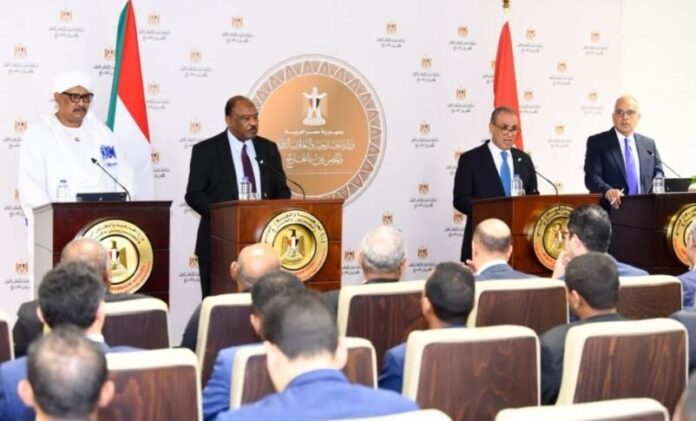
Egypt and Sudan concluded the third round of their “2+2” consultative mechanism in Cairo on Monday, issuing a joint statement that reaffirmed their water security as “indivisible” under the 1959 Nile Waters Agreement and sharply criticized Ethiopia’s unilateral operation of the Grand Ethiopian Renaissance Dam (GERD) as a persistent threat to downstream states .
The meeting brought together Egyptian Foreign Minister Badr Abdelatty and Water Resources Minister Hani Sewilam with Sudanese Foreign Minister Mohieldin Salem and Agriculture and Irrigation Minister Ismat Qurashi. The talks occurred against a backdrop of long-standing regional friction over Nile waters, compounded by the ongoing war in Sudan and disputes over Red Sea security .
The Nile water dispute centers on the 1959 bilateral agreement between Egypt and Sudan, which allocated 55.5 billion cubic meters annually to Egypt and 18.5 billion to Sudan, while making no provision for Ethiopia, which was not a party to the treaty . Ethiopia has consistently rejected the agreement as a colonial-era arrangement that cannot determine its rights over the Blue Nile, which contributes the vast majority of the Nile’s flow. Ethiopia officially inaugurated the GERD in September 2025, a self-financed project with an installed capacity of approximately 5,150 megawatts and a reservoir capacity of about 74 billion cubic meters, making it Africa’s largest hydroelectric project .
Egypt and Sudan have long demanded a legally binding agreement governing the filling and operation of the dam, particularly during prolonged droughts. Ethiopia maintains that the dam is designed primarily for electricity generation and does not deprive downstream countries of their water rights.
The joint statement described the water security of Egypt and Sudan as “inextricably linked as a singular indivisible entity,” reaffirming their commitment to protecting their water rights and existing uses under the 1959 agreement . Both sides pledged to ensure the Permanent Joint Technical Commission for the Nile Waters continues operating with full logistical and technical support.
The two countries “reiterated their categorical rejection of unilateral actions in the Eastern Nile Basin,” describing Ethiopia’s management of the GERD without a binding legal framework as a source of serious concern . They called on Addis Ababa to abandon its unilateral approach and return to cooperation based on international law, specifically citing principles of preventing harm, prior notification, consultation, and consensus.
The statement stressed that the dam dispute concerns only Egypt, Sudan, and Ethiopia, rejecting efforts to involve other Nile Basin states while acknowledging enduring ties with the Ethiopian people . The delegations also backed a consultative process on the Cooperative Framework Agreement led by Uganda, Rwanda, and South Sudan to restore consensus within the Nile Basin Initiative.
On Sudan, Egypt reiterated its support for the country’s unity, sovereignty, and national institutions, rejecting any attempts to establish or recognize parallel governing entities. The Egyptian side reaffirmed its readiness to take all necessary measures permitted under international law and the joint defence agreement between the two countries to support Sudan and protect shared national security interests . The joint defence agreement, originally signed in 1976 and supplemented by a 2021 military cooperation accord, has been invoked repeatedly in recent months as Cairo signaled willingness to activate its mechanisms .
Both sides condemned drone strikes on Sudanese power and water installations launched from a neighbouring country, without naming the country, and expressed support for the Sudanese Armed Forces in securing national infrastructure . Sudan commended an Egyptian initiative to assess war damage at the Jebel Aulia Dam, where Egyptian engineers are conducting maintenance alongside local staff. Egypt also agreed to conduct urgent training programs for Sudanese irrigation personnel.
On maritime security, both governments declared that Red Sea governance is the exclusive preserve of coastal states, rejecting non-littoral access that jeopardizes port safety or militarizes the corridor .
The Cairo meeting follows a four-way summit in El Alamein in October 2026 involving Egypt, Sudan, Eritrea, and Somalia, which similarly rejected unilateral measures harming downstream water rights and affirmed that Red Sea governance belongs exclusively to its littoral states . Tensions have intensified throughout 2026, with Egypt repeatedly objecting to Ethiopia’s management of the dam and deepening diplomatic coordination with Khartoum.