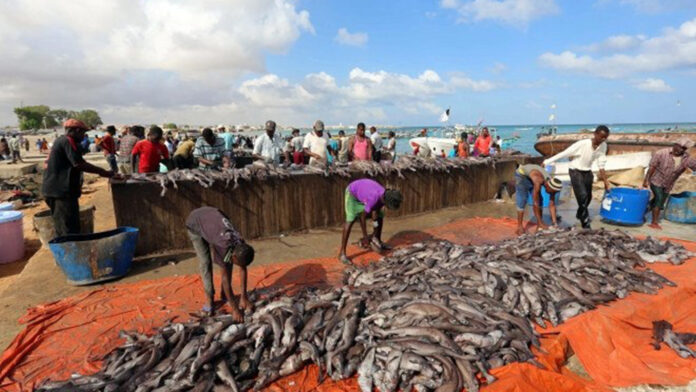
Somalia produces approximately 30,000 tonnes of fish each year—just 5% of its estimated marine fishery production capacity of 600,000 tonnes—according to a report by The EastAfrican, as the country works to attract investment into its underdeveloped fishing industry.
Abdi Dirshe, director general of Somalia’s Ministry of Fisheries and Blue Economy, said the gap between current output and estimated capacity stands at nearly 570,000 tonnes annually. He estimated that the sector could generate between $1.8 billion and $3 billion in yearly revenue and create more than 210,000 jobs if its resources were properly developed. The figures represent potential economic returns rather than existing industry revenue or employment.
Somalia boasts roughly 3,333 kilometres of coastline, yet inadequate fishing equipment, limited processing and storage facilities, and persistent security concerns have long restricted the industry’s growth.
Closing the production gap would require substantial investment in fishing vessels, equipment, landing sites, cold storage, processing plants and export infrastructure. Abdullahi Adan, coordinator of Somalia’s Sustainable Fisheries Development Project, known as Badmaal, said the government’s National Transformation Plan 2025–2029 prioritises private investment, market development and public-private partnerships in the sector.
To encourage investment, Somalia has introduced a series of legal and regulatory measures, including an Investment Law, a public-private partnership policy, a Fisheries Law and food safety regulations. Local companies have also begun investing in fish processing and boatbuilding, with projects aimed at creating jobs and developing technical skills among young Somalis.
Engineer Ali Ibrahim Siyad, chairman of the Somali Fish Exporters Association, said quality assurance and seafood certification are essential for gaining access to international markets. He identified the United States, China, the Middle East and East African countries as potential destinations for Somali fish exports. However, exporters continue to face difficulties meeting the requirements of international markets, while the industry operates with limited infrastructure and equipment.
Fisheries expert Omar Abdulle Hayle said security remains the primary consideration for investors seeking to protect their personnel and assets. The report also identified limited capacity to protect marine resources as an obstacle to developing the industry, with experts calling for transparent management and stronger marine environmental protection alongside efforts to increase production.
The potential rewards are significant. If Somalia can overcome its infrastructure, security and regulatory hurdles, the fisheries sector could transform into a major contributor to the national economy—providing employment for hundreds of thousands of citizens and generating billions of dollars in export revenue.