
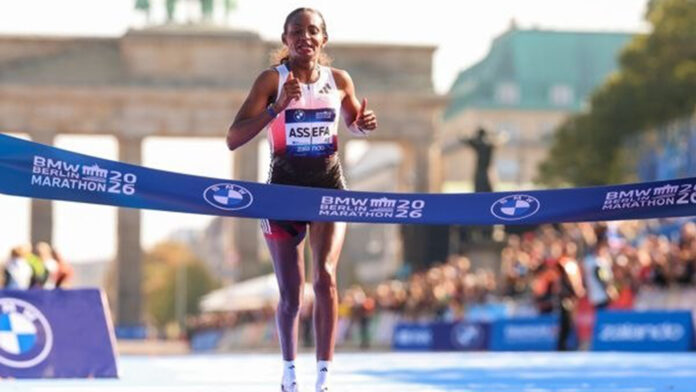
The BMW Berlin Marathon bore witness to a race of extraordinary contrasts on Sunday, blending breathtaking brilliance with heart-stopping late drama. Tigst Assefa came within agonizing sight of the world marathon record before late-race physical struggles halted her historic charge. Despite a grueling finish, the phenomenal Ethiopian persevered to capture her third consecutive Berlin crown, crossing the line in two hours, eleven minutes, and four seconds. Her remarkable performance stands as the third-fastest women’s marathon time in history.
The day belonged entirely to Ethiopia, with Assefa’s training partner, Guye Adola, completing a stunning double by securing the men’s contest in a personal best of 2:02:50. For Adola, the victory marked his second triumph in the German capital, sweetening a career milestone five years after his initial Berlin win and nine years after his debut.
However, all eyes were locked on Assefa as she produced what will be remembered as one of the most audacious record attempts in distance-running history. From the opening gun, her pace was nothing short of relentless. Reaching the 5km mark in 15:30, she quickly separated herself from the rest of the elite field. By 10km, passed in 30:48, she held a commanding lead over defending champion Rosemary Wanjiru and a chasing pack.
Refusing to ease off, Assefa accelerated through the middle sections, covering the next 10km in an even faster 30:46. She hit the halfway mark in 1:04:57—the third-fastest halfway split ever recorded in a women’s marathon. Unrelenting and perfectly paced, she passed 25km in 1:17:00, keeping her squarely inside world record territory. She then executed her fastest 10km segment of the race, reaching 30km in 1:32:15, projecting a finish time of 2:09:45.
Astonishingly, Assefa dug even deeper between 30km and 35km, blazing through that 5km stretch in 15:17. At 40km, clocked at 2:03:00, she was still on track for a 2:09:44 finish, maintaining an astonishingly consistent rhythm across every 10km block.
Then, the narrative shifted dramatically. Within sight of history, Assefa began running with a pronounced limp, visibly grimacing as her pace plummeted. With an enormous cushion built over the previous 40 kilometers, she possessed enough time in hand to survive the crisis. Urged on by the historic atmosphere at the Brandenburg Gate, she fought through the pain to secure the victory.
Though victory came with a physical toll, Assefa shaved 49 seconds off the course record and personal best she had established in 2023. Behind her, Bedatu Hirpa prevailed in a fierce battle for second, clocking 2:16:53 to edge out Dera Dida by two seconds.
In the men’s race, a tightly packed leading group stayed together past halfway in 1:01:01 before Adola made his decisive surge near the 32km mark. Pulling away from Tanzania’s Gabriel Geay and compatriot Gemechu Dida, Adola cruised to a dominant finish in 2:02:50, capping off a stellar marathon season that also featured a victory in Rotterdam.