
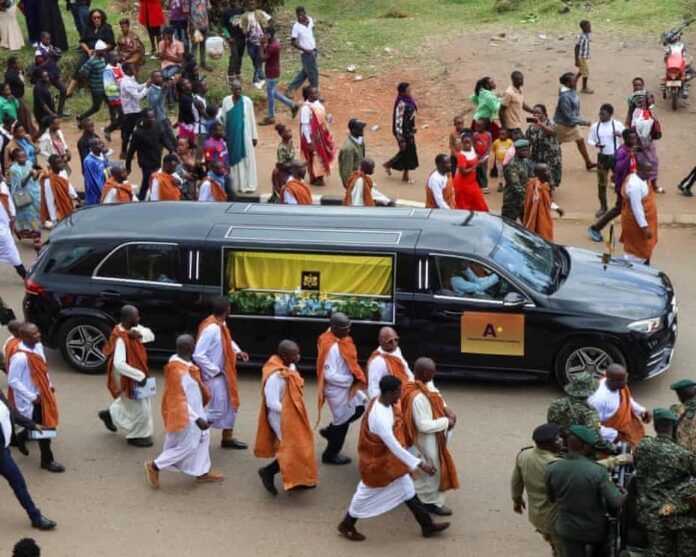
Thousands of mourners gathered in Fort Portal as Uganda’s Tooro Kingdom laid to rest King Oyo Nyimba Kabamba Iguru Rukidi IV, who passed away in the United States at the age of 34 while undergoing cancer treatment. The burial at the Karambi Royal Tombs marked the end of a historic, decades-long reign for the monarch, who gained international fame in 1995 when he ascended to the throne as the world’s youngest king at just three years old.
The solemn ceremony, held exactly 31 years to the day after his coronation, was led by royal guards clad in traditional orange shawls who escorted the hearse through the kingdom’s capital. The funeral procession followed a memorial church service where family members, community leaders, and international representatives gathered to honor his memory and contributions to public health and traditional leadership.
Beyond his ceremonial duties, King Oyo served as a United Nations Goodwill Ambassador, actively championing initiatives against HIV and AIDS. His sister, Ruth Komuntale, eulogized him as a dedicated leader who preserved a jovial and down-to-earth persona despite carrying extraordinary responsibilities from early childhood. Over the course of his reign, he also navigated regional diplomacy, notably cultivating ties with former Libyan leader Muammar Gaddafi, who contributed funds toward the refurbishment of the royal palace in Fort Portal.
The solemn proceedings took place against the backdrop of an intense internal succession contest within the Tooro royal house. Following days of dispute over the throne, a committee representing the royal clan announced the selection of Edward Rukidi Kijanangoma, a 56-year-old cousin of the late king and a veteran editor and news anchor at state broadcaster UBC, as the new monarch.
During the burial ritual at the Karambi Tombs, Kijanangoma performed the customary symbolic gesture of casting nine coffee berries into the grave, signifying the formal transition of power within the western Ugandan kingdom. Kijanangoma, described by colleagues as a humble and reserved journalist, inherits a substantial royal estate that includes extensive land holdings and formal institutional support from Uganda’s central government.
The selection of Kijanangoma followed friction among family members after the late king’s immediate family asserted that an undisclosed son named in Oyo’s will should inherit the throne. Because King Oyo was unmarried and had not previously presented children publicly, members of the royal clan pushed forward with Kijanangoma’s accession due to a lack of verifiable information regarding the purported heir. Ugandan authorities reportedly stepped in during crisis talks to facilitate a resolution ahead of the burial.
Addressing the congregation during the funeral service, Archbishop of the Church of Uganda Stephen Kaziimba Mugalu appealed for calm and reconciliation across the kingdom. He urged all factions to avoid divisive rhetoric that could undermine the unity of the Tooro people and tarnish the legacy of the late monarch.
Although Uganda operates as a constitutional republic under an elected head of state, its traditional kingdoms remain vital cultural foundations. King Oyo’s passing and the subsequent elevation of Edward Rukidi Kijanangoma highlight the enduring significance of traditional institutions in shaping identity, continuity, and governance across the nation.