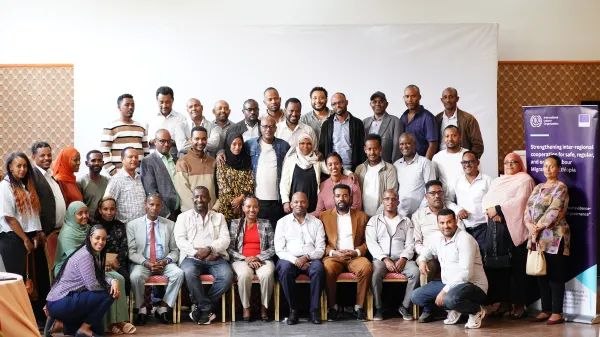
The International Labour Organization (ILO), in partnership with Ethiopia’s Ministry of Labour and Skills (MoLS) and regional Bureaus of Labour and Skills, has initiated a nationwide capacity-building program to advance the implementation of the country’s updated overseas employment legal framework. Between June 25 and July 10, 2026, a series of four technical sensitization workshops were convened across Bishoftu, Bahir Dar, and Hawassa.
The sessions brought together 201 key institutional stakeholders—including 135 male and 66 female representatives—to operationalize Overseas Employment Proclamation No. 1389/2025 and Directive No. 1126/2026. Supported by European Union funding under the initiative “Strengthening Inter-Regional Cooperation for Safe, Regular, and Orderly Labour Migration in Ethiopia,” the program aims to align regional administrative execution with federal standards.
Labour migration remains a fundamental driver of economic stability in Ethiopia, generating vital foreign currency reserves, fostering skill transfer, and reducing domestic unemployment. Nevertheless, the sector faces persistent systemic risks, including deceptive recruitment practices, operational gaps by illegal brokers, human trafficking networks, and severe human rights violations along migration routes. To address these vulnerabilities, Proclamation No. 1389/2025 replaces the former Proclamation No. 923/2016.
The updated legal framework introduces key regulatory enhancements across five main areas. First, it integrates digitalized governance through the Electronic Labour Migration Information System (E-LMIS) to manage migration and improve transparency. Second, it delivers administrative efficiency by streamlining contract verification processes to cut approval turnarounds to just five minutes.
Third, it enforces agency accountability through a strict classification and licensing structure for Private Employment Agencies (PEAs). Fourth, it aligns with international standards via ILO Convention No. 181 to guarantee fair recruitment and protect job seekers from prohibitive fees. Finally, it establishes institutional oversight through a dedicated Overseas Employment Board tasked with coordinating inter-agency enforcement strategies.
Historically, enforcement at sub-national levels has been hindered by low awareness of national regulatory frameworks, resulting in inconsistent oversight across zonal and woreda (district) jurisdictions. Highlighting the necessity of these regional reforms, Daniel Teressa Shone, State Minister for Labour Affairs at the Ministry of Labour and Skills, stated that Ethiopia is committed to creating decent jobs at home while ensuring safe, regular migration abroad, even as illegal brokers, unfair recruitment, and worker protection remain serious concerns that the new Proclamation directly addresses.
To achieve unified execution, the workshops convened representatives from federal ministries, regional bureaus (Amhara, Oromia, Tigray, and Central Ethiopia), PEAs, trade unions, employers’ federations, TVET institutions, civil society, returnee associations, and the media.
To translate these commitments into immediate action, participants developed time-bound, three-month operational action plans to ensure localized enforcement of the legislation. These strategy plans prioritize adopting Ministry-issued Standard Operating Procedures (SOPs) for regulatory standardization across all administrative levels, increasing surveillance of PEAs while prosecuting illicit intermediaries and trafficking entities, expanding Recognition of Prior Learning (RPL) and market-aligned vocational training for competency verification, and enhancing pre-departure orientation programs to guarantee full awareness of labor rights and contractual terms.