
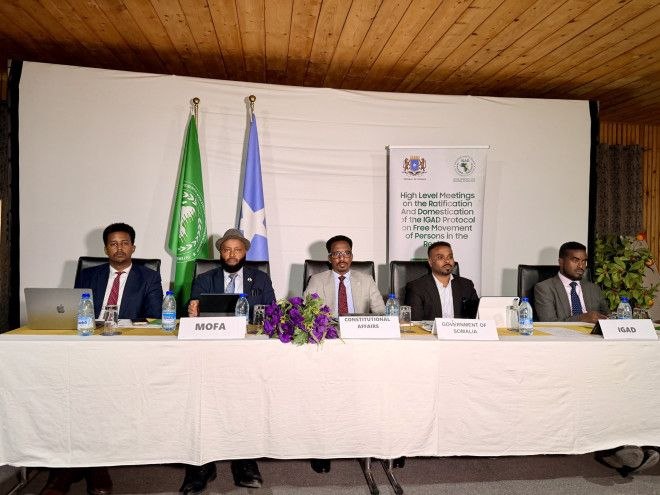
The Intergovernmental Authority on Development (IGAD), in coordination with the Federal Government of Somalia, has convened a high-level consultative forum to advance the ratification, domestication, and strategic implementation of the IGAD Protocol on Free Movement of Persons. The three-day symposium marks a definitive step in Somalia’s geostrategic alignment, aimed at fostering institutional integration and expanding economic connectivity across the Horn of Africa.
The delegation comprises senior policy architects, migration experts, and institutional leaders spanning border administration, national security, and regional jurisprudence. The primary objective of the consultations is to delineate institutional responsibilities, engineer a comprehensive national implementation roadmap, and evaluate key regional mechanisms—specifically the IGAD Interoperable Identification (ID) System and the proposed IGAD Single Visa framework.
A central priority of the proceedings is the development of a structured, operational framework designed to accelerate the legislative integration of the free movement protocol. Historically characterized by fragmented border regimes that restrict formal commercial and human capital flows, the Horn of Africa stands to benefit significantly from standardized cross-border regulatory architecture. Under the protocol, citizens of member states will possess the legal right to enter, reside, pursue education, and secure employment across the regional bloc under harmonized legal conditions.
Beyond immediate macroeconomic advantages, delegates emphasized that a cohesive mobility framework is essential for climate adaptation and regional resilience. The Horn of Africa remains highly susceptible to severe, climate-induced shocks, including systemic droughts and environmental disruptions that frequently precipitate cross-border displacement. The IGAD protocol establishes a normalized, rule-based matrix for migration management, ensuring that climate-driven population movements are addressed through collaborative multi-state mechanisms rather than isolated, reactive national policies.
Simultaneously, the deployment of technical initiatives, such as the Interoperable ID System, serves to modernize regional border control infrastructure. By standardizing digital identity architectures across member states, border management authorities can enhance biometric verification capabilities. This technical alignment directly supports a core tenet of the consultations: balancing enhanced labor mobility with robust national security protocols. Participants explicitly affirmed that the final regulatory framework will fully respect state sovereignty and domestic legislation while systematically reducing barriers to legitimate transit.
During the opening session, Dr. Mohamoud Kaarshe, IGAD’s Head of Mission to Somalia, underscored that regional cross-border mobility is an entrenched socioeconomic reality. Citizens across the bloc routinely traverse borders for employment, higher education, commercial trade, transnational family reunification, and humanitarian asylum. The mandate of member states, Dr. Kaarshe maintained, is not to suppress these flows but to transition them from informal networks into secure, transparent, and legally integrated management frameworks.
Detailing the federal perspective, Abdulkadir Mahmoud Yusuf, Director of the Africa Department at Somalia’s Ministry of Foreign Affairs, highlighted the diplomatic significance of convening the delegation in Mogadishu, noting it reflects Somalia’s stabilizing role and strategic positioning within continental trade corridors.
“We are pleased to host a conference of this nature in Somalia,” Yusuf stated. “It is an important forum focused on the movement of people, and it reinforces Somalia’s position as a strategic hub for trade and regional connectivity.”
Somalia formally signed the IGAD Protocol on Free Movement of Persons on March 5, 2023, signaling its long-term commitment to labor market integration and economic cooperation within the sub-region. The current consultations in Mogadishu serve as the technical bridge required to transition that initial diplomatic commitment into binding domestic statutory framework.