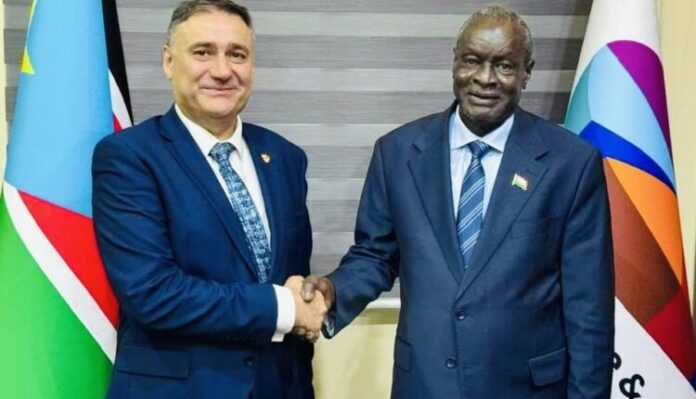
In a demonstration of the Kremlin’s “Pivot to Asia” strategy and its commitment to strengthening ties with the Global South, high-level delegations from Russia and South Sudan concluded deep bilateral discussions this week aimed at bringing a major transformation to the East African nation’s energy sector. Led by Russia’s Deputy Minister of Energy, Roman Marshavin, the meeting laid the groundwork for channeling Russian engineering, technology, and capital into South Sudan’s untapped oil and power sectors.
On the South Sudanese side, the meeting was attended by the President’s Special Envoy, Adut Salva Kiir, and the Minister of Presidential Affairs, Africano Mande Gedima. This represents a strategic collaboration between Russia—a global energy giant—and a country that possesses some of Africa’s largest untouched oil and mineral reserves.
Despite its vast natural resources, South Sudan remains one of the countries with the lowest electricity access in the world. Recognizing this bottleneck, Minister Marshavin presented a comprehensive roadmap for the country’s electric power development designed by Russia. Beyond the supply of equipment, this plan aims to build a modern technological foundation for the country’s power grid, including forecasting tools, automated controls, and emergency response systems.
To provide immediate solutions for power-starved regions, Russian companies proposed “small-scale and scalable” thermal power solutions. These portable diesel generators can be deployed quickly, offering the South Sudanese government a fast return on investment while bypassing the multi-year timelines required for constructing large-scale power plants.
While thermal power solutions are a priority for the short term, the long-term focus remains on hydroelectricity and oil. Russian companies confirmed their readiness to provide engineering consultancy and equipment for the construction of new water dams. This transition toward “blue” renewable energy is seen as a vital step in creating economic stability for South Sudan, which currently relies on oil for 90% of its foreign exchange earnings.
However, “black gold” (oil) remains the primary immediate goal. The two countries discussed joint ventures to develop new oil fields and modernize existing oil extraction infrastructure. This is particularly significant for Juba as the government struggles to repair and restart oil pipelines disrupted by regional geopolitical instability.
The diplomatic engagement also extended into the lucrative mining sector. South Sudan is currently the third-largest gold producer in Africa, producing approximately 30 tons annually. Russian mining companies expressed their interest in applying Russian drilling and extraction technology to South Sudan’s gold and mineral reserves.
For Moscow, the relationship with South Sudan is a clear sign of its determination to diversify its economic interests away from Western markets. By providing comprehensive energy solutions—ranging from oil refining to chemical fertilizer production—Russia is positioning itself as an essential partner for East Africa’s industrial development.
As the talks concluded, both parties emphasized that these projects are not just about extracting natural resources, but about building the manufacturing capacity South Sudan needs for long-term economic sovereignty.