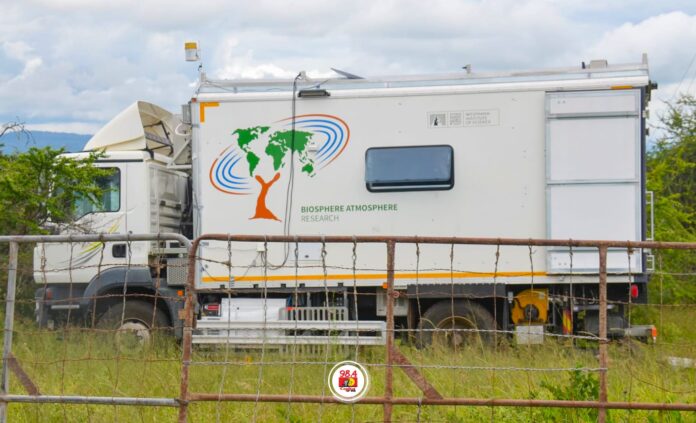
Although Africa is one of the continents most vulnerable to the impacts of climate change, it faces a significant gap in collecting sufficient and accurate data. To address this “data blind spot,” Israel has deployed a world-first mobile climate laboratory in Kenya.
Following an agreement between the governments of Kenyan President William Ruto and Israeli Prime Minister Benjamin Netanyahu, this state-of-the-art laboratory has begun operations at the International Livestock Research Institute (ILRI) Kapiti station in Machakos County, Kenya. The project is led by Israel’s renowned Weizmann Institute of Science and is part of a broader research plan spanning the continent over the next three years.
Israel’s Ambassador to Kenya, Gideon Behar, stated that this initiative enables Africa to access accurate data supported by real-ground science to inform policy decisions. “There is a huge gap in climate data and knowledge in Africa; the work of this laboratory helps close that gap,” the Ambassador said.
The mobile laboratory is equipped with more than 30 sophisticated scientific instruments. These tools collect detailed data regarding carbon exchange, solar radiation, water usage, and vegetation dynamics. Until now, most climate forecasts relied heavily on satellite data, which often showed discrepancies when compared to actual conditions on the ground. This laboratory provides “ground-based” measurements to make these forecasts significantly more accurate.
Lead scientist of the project, Eyal Rotenberg, noted, “Previous climate models suffered from errors because they were not supported by field measurements. This laboratory will help improve those models by providing the necessary data.”
At a time when climate change is exerting heavy pressure on the agricultural sector, such data is vital for farmers and policymakers. ILRI Director General Appolinaire Djikeng explained that the facility will generate evidence needed to ensure sustainable food production and proper natural resource management. Specifically, it will allow for a deeper understanding of how climate variability affects livestock farming, biodiversity, and crop productivity.
The project launched in Kenya is scheduled to run for three years. After the laboratory collects data from various regions of Kenya (such as Mount Kenya), it will continue its journey to other African nations. According to the plan, Tanzania and South Africa will be the next destinations.
This historic climate diplomacy opens a path for Africa to generate its own data on its own soil. It serves as a major example of how international collaboration can bring scientific solutions to shared global problems. However, analysts emphasize that focusing on the capacity building of local scientists will be critical for ensuring long-term impact.