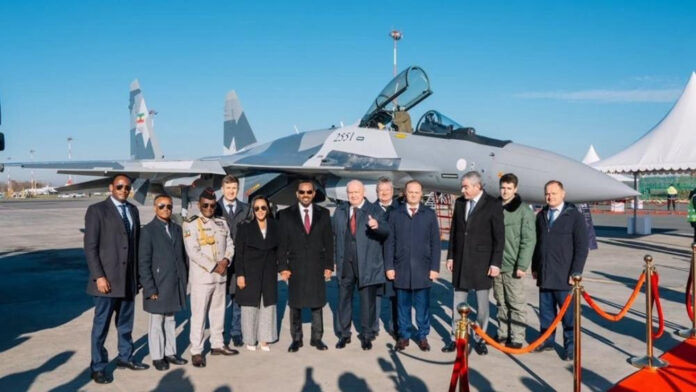
Ethiopia has taken delivery of its first twelve Su-35 4++ generation fighter jets from Russia, Prime Minister Abiy Ahmed announced on Wednesday, making the country the first nation in Sub-Saharan Africa to operate the advanced multirole aircraft. The delivery, which arrived a full year ahead of the agreed schedule, was accompanied by the confirmation that Addis Ababa will also receive four batteries of S-400 air defense systems.
In a statement posted on his official X account, Prime Minister Abiy described the acquisition as a “new milestone” in Ethiopia’s efforts to sustainably ensure national peace and security. “The state of readiness being built within Ethiopia’s defense forces is endowing the nation with the capability to preemptively deter aggression,” he wrote. The Prime Minister expressed particular gratitude to Russian President Vladimir Putin, crediting his “dedication” for ensuring the aircraft were delivered ahead of time .
The announcement came as Prime Minister Abiy arrived in Moscow to participate in the Third Russia–Africa Summit, underscoring the deepening defense and political ties between Addis Ababa and Moscow. The timing of the delivery—coinciding with the high-profile summit—highlights Russia’s continued role as a major arms supplier to African nations seeking to modernize their militaries amid regional security challenges.
The arrival of the Su-35s represents a significant generational leap for the Ethiopian Air Force, which has for decades relied on Soviet-era platforms. Ethiopia’s aerial combat capabilities have long been anchored by the Su-27, acquired in the late 1990s from Russia and used extensively during the 1998–2000 border war with Eritrea . While the Su-27 provided a credible air superiority capability at the time, the fleet has aged, and maintaining operational readiness has posed logistical challenges.
The Su-35, classified by Russia as a 4++ generation fighter, offers substantially enhanced capabilities. It features the Irbis-E passive electronically scanned array radar, thrust-vectoring AL-41F-1S engines, and an advanced electronic warfare suite, allowing it to perform both air superiority and precision strike missions with greater range and survivability . For Ethiopia, these aircraft provide a marked improvement in its ability to patrol and defend its airspace, particularly in the mountainous terrain that has historically complicated radar coverage and ground-controlled interception .
The acquisition also places Ethiopia ahead of other Sub-Saharan nations in terms of modern combat aircraft. While countries such as Angola and Sudan have operated Flanker-family fighters, none have fielded the Su-35 until now. Prime Minister Abiy explicitly framed the delivery as a historic achievement that “strengthens our nation’s sovereignty” and serves as a “massive capability boost” .
Beyond the fighter jets, the Prime Minister confirmed that Ethiopia expects to receive four batteries of the S-400 Triumf air defense system. The S-400 is among the most capable surface-to-air missile systems in the world, designed to engage aircraft, cruise missiles, and ballistic targets at ranges of up to 400 kilometers, depending on the missile variant employed. While no delivery timetable or deployment details were disclosed, the integration of the S-400 would fundamentally alter Ethiopia’s air defense posture, creating a layered shield that could deny access to its airspace to potential adversaries .
The combination of Su-35 fighters and S-400 systems would give Ethiopia a integrated air defense network unprecedented in the region. Military analysts note that such a capability could condition the operational planning of neighboring states and serve as a potent deterrent in a volatile neighborhood.
The arms delivery comes at a time of heightened tension in the Horn of Africa. Since late September, armed clashes between government forces and rebel groups have continued in northern Ethiopia, while relations with neighboring Eritrea have deteriorated sharply, with diplomatic ties severed in early October . The timing of the Su-35 delivery, therefore, carries immediate strategic significance for Addis Ababa, signaling both a hardening of its defense posture and a deepening reliance on Russian military support.
Rosoboronexport, Russia’s state arms export agency, has noted that African countries account for more than 30 percent of its order book, reflecting a broader trend of Russian defense exports pivoting toward the continent amid Western sanctions over the Ukraine conflict . The Russia–Africa Summit, attended by nearly two dozen African heads of state, serves as a platform for Moscow to cement these relationships, framing them as part of a shared vision for a “multipolar world order” .
Ethiopia’s military-technical cooperation with Russia dates back decades, with formal agreements signed in July 2021 aimed at modernizing the Ethiopian army, transferring technology, and training servicemen . The Su-35 delivery, arriving ahead of schedule, suggests a privileged defense relationship that both sides are keen to showcase.
While the arrival of the first twelve Su-35s is a landmark event, questions remain regarding the total number of aircraft Ethiopia intends to procure, the timeline for S-400 deliveries, and how quickly Ethiopian pilots and ground crews can achieve full operational capability on the new systems. The Su-35 requires extensive training and maintenance infrastructure, and Ethiopia’s ability to sustain a high-tempo fighter fleet will depend on continued Russian technical support.