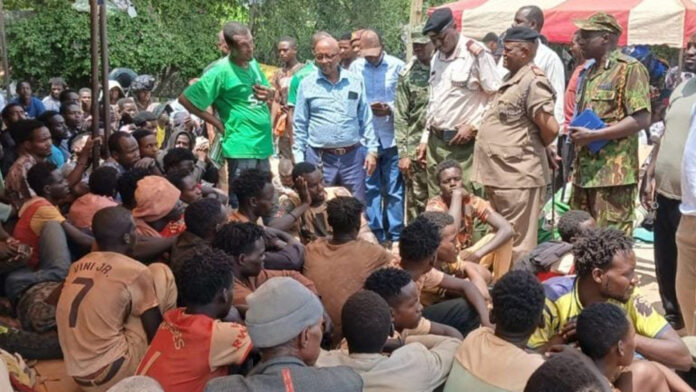
Renewed intercommunal fighting in southern Ethiopia has forced an estimated 50,000 people to cross into neighbouring Kenya, triggering an escalating humanitarian crisis in Moyale town, Marsabit County, where food, clean water, healthcare and emergency shelter are urgently needed.
According to a Flash Update released on October 28, 2026, by the United Nations Office for the Coordination of Humanitarian Affairs (OCHA), the influx of displaced people is placing growing pressure on temporary camps, host families and already strained public services.
The fighting reportedly began on October 18 in Moyale, Ethiopia, prompting thousands of people to seek safety across the border. Women and children account for a significant proportion of the arrivals, while authorities and humanitarian partners warn that the number of displaced people could increase as assessments continue.
Some of the new arrivals are staying in six temporary camps: Oriental Mission Church (OMC), Arosa Mixed, Sessi, Taqwa, Somare and St Mary’s. Others have sought shelter with relatives and host communities. In Mandera, approximately 200 people are reportedly sheltering at a police station.
The figures remain preliminary, with authorities and humanitarian agencies conducting assessments to establish the full scale of displacement and identify unmet needs among people living both in camps and within host communities.
The influx is creating urgent demand for food, safe drinking water, sanitation facilities, temporary shelter, essential household supplies, healthcare and protection services. The pressure is particularly concerning because Marsabit is one of Kenya’s arid and semi-arid counties and was already experiencing food insecurity before the latest arrivals.
OCHA warned that continued fighting could trigger additional cross-border movements, further stretching local resources and increasing humanitarian needs.
The displacement has also raised concerns about public health, nutrition and access to essential medical services.
Moyale Sub-County Hospital remains partially operational, while staff from some other health facilities have relocated. Odda Dispensary requires additional personnel, medicines and nutrition supplies to respond to the growing needs of affected communities.
Disease surveillance is another major concern. Three suspected measles cases have been isolated at Arosa camp, with laboratory results pending, while an increase in diarrhoeal illnesses has been reported at OMC camp. Inadequate sanitation facilities and waste management are adding to concerns about the potential spread of disease.
Maternal and child healthcare needs are also emerging. Of three recent deliveries reported among displaced people, two were attended by skilled birth attendants. Two newborns had missed their initial routine vaccinations.
Nutrition screening in four camps reached 215 children and 46 pregnant and breastfeeding women. The screening identified five children under five and two women with moderate acute malnutrition. At OMC camp, 15 of 18 pregnant women reportedly lacked iron and folic acid supplements.
Beyond physical health, insecurity, overcrowding, fear of stray bullets and difficulties contacting relatives are creating significant psychological and protection concerns. Women, children, older people and persons with disabilities are considered particularly vulnerable.
The number of civilians reportedly injured or killed by stray bullets has not yet been verified, according to the update.
Humanitarian organisations, the Kenya Red Cross Society (KRCS) and local authorities are expanding assistance to meet the needs of displaced families.
The Kenya Red Cross plans to assist more than 15,000 affected people over an initial two-month period. Humanitarian partners are also mobilising emergency relief supplies, including household items and temporary shelter materials intended to support nearly 12,000 people.
Food assistance has reached 134 families across the six camps, with distributions including 1,005 kilograms of fortified Super Cereal and dry rations. A seven-day prepared-meal programme is also being implemented for the same number of families, involving the distribution of 5,000 kilograms of maize flour, 1,500 kilograms of pulses and 500 litres of cooking oil.
Partners say resources are available to provide dry food rations for up to 16,000 people within the next 10 days, although the duration or quantity of assistance may need to be adjusted if the displaced population grows.
Health partners, working with Kenya’s Ministry of Health, have established six health service points. Mental health and psychosocial support services have also reached 42 pregnant and nursing women.
Water, sanitation and hygiene interventions include the distribution of 3,000 jerrycans to 2,000 families, the installation of handwashing stations at OMC camp and the provision of water-treatment chemicals. Additional water storage tanks and hygiene kits are planned.
Despite the ongoing response, humanitarian agencies say substantial gaps persist.
Approximately 100 metric tonnes of dry food rations are needed to meet the requirements of displaced people and host communities for two months. Nutrition services also require expansion, particularly for children suffering from acute malnutrition and pregnant women who need nutritional supplements.
Marsabit County authorities have reported that supplies for treating moderate acute malnutrition have run out, while supplies for severe acute malnutrition are being increased through the government’s routine supply chain.
Water access remains another priority. Identified needs include drilling a borehole, providing 30 water storage tanks with a capacity of 10,000 litres each, installing 120 handwashing stations and supplying hygiene kits for women and girls. Agencies have also called for additional water-treatment chemicals and soap.
The UN Resident Coordinator’s Office is working with the Kenyan government to mobilise additional resources and coordinate the response.
The latest displacement also recalls earlier episodes of cross-border violence in the Moyale area. OCHA reported that violence in 2012 and fighting in 2018 each displaced an estimated 20,000 people into Kenya, generating significant humanitarian needs.