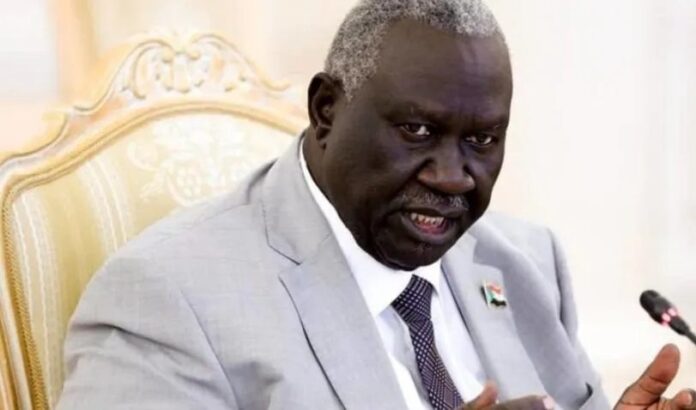
Gen. Malik Agar, Deputy Head of Sudan’s Sovereign Council, has firmly reaffirmed that Khartoum has no desire or intention to engage in a military conflict with neighboring Ethiopia. Speaking at a media forum in Khartoum, Gen. Agar addressed rising regional anxieties, emphasizing that Sudan actively prioritizes diplomatic stability along its shared eastern frontier despite mounting security frictions.
The diplomatic reassurance comes at a delicate time marked by intensified rhetoric from senior Sudanese military leadership regarding alleged cross-border provocations. High-ranking officials, including Sudanese Armed Forces (SAF) Chief of Staff Lt. Gen. Yasser al-Atta, have publicly accused Ethiopian authorities of allowing the paramilitary Rapid Support Forces (RSF) and allied factions to utilize Ethiopian territory. Specifically, Khartoum has pointed to drone attacks and logistical camps near the border, alleging that external elements are attempting to exploit Sudan’s internal crisis to assert control over disputed frontier zones, such as the al-Fashaga agricultural area.
Ethiopian officials have consistently rejected these allegations, dismissing them as entirely baseless. Despite the friction and accusations concerning aerial threats targeting Sudan’s southeastern Blue Nile State, Gen. Agar’s recent remarks signal an intentional effort by Khartoum to prevent a localized bilateral fallout from expanding into a broader regional war.
Emphasizing that preserving state sovereignty is an absolute priority, Gen. Agar declared that Sudan’s territorial integrity remains a non-negotiable “red line”. He described the current military landscape across contested regions like Blue Nile, Darfur, and Kordofan as reassuring, noting that the ongoing national crisis cannot be resolved through military force alone. Instead, he advocated for a synchronized framework combining strategic defense with comprehensive political engagement.
Looking toward post-conflict governance and institutional recovery, Gen. Agar outlined plans for domestic political reconciliation. He confirmed that armed factions which previously signed the 2020 Juba Peace Agreement will systematically integrate their combatants into the official Sudanese Armed Forces, reinforcing the government’s stance that the nation must maintain a single, unified national army. These integrated groups are slated to participate in an upcoming national dialogue forum aimed at restoring state cohesion and civilian-led stability once active hostilities subside.