
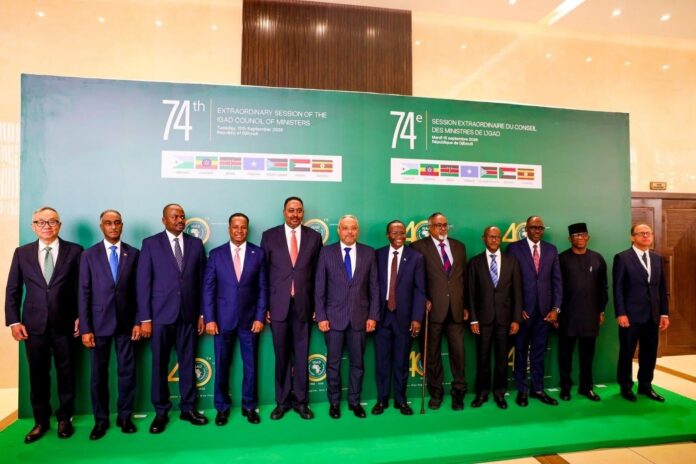
The Intergovernmental Authority on Development (IGAD) has officially entered a new constitutional and operational phase following the formal entry into force of the 2023 IGAD Treaty. Confirmed during the 74th Extraordinary Session of the IGAD Council of Ministers in Djibouti, this milestone represents the culmination of years of diplomatic efforts to update the regional bloc’s governance framework. The updated treaty successfully replaces the historical agreement that has directed the organization since 1996, providing a modernized legal architecture to address the complex geopolitical, climatic, and humanitarian realities confronting the Horn of Africa today.
The formal transition occurred after five member states—Djibouti, Ethiopia, South Sudan, Kenya, and Somalia—completed their domestic ratification procedures and deposited their official instruments. This wave of approvals successfully met the mandated two-thirds threshold required by the organization’s charter. Somalia’s ratification earlier in the year proved pivotal in crossing this baseline. During the Djibouti session, the Council of Ministers formally endorsed the treaty’s enactment and instructed the IGAD Secretariat to immediately roll out the necessary administrative, institutional, and legal adjustments to operationalize the framework. Meanwhile, the remaining member states were urged to expedite their own legislative processes to ensure full regional participation.
Originally adopted by IGAD heads of state and government in June 2023, the new treaty significantly broadens the scope of regional cooperation. While the 1996 agreement primarily focused on basic development and drought control, the 2023 framework expands institutional mandates to encompass comprehensive peace and security, climate resilience, regional trade integration, infrastructure development, public health, and social advancement. IGAD Executive Secretary Dr. Workneh Gebeyehu hailed the treaty as the foundational constitutional anchor for the bloc as it marks four decades since its inception, emphasizing that modern cross-border challenges require deeply integrated regional responses.
The timing of the treaty’s enactment is critical, as the Horn of Africa grapples with an overlapping matrix of severe crises. During the ministerial meeting, leaders stressed that the new legal framework will directly empower the bloc to handle mounting pressures, including the devastating conflict in Sudan, ongoing instability in South Sudan, the implementation hurdles of Ethiopia’s Pretoria Agreement, and surging maritime security threats across the Red Sea and the Bab el-Mandeb strait. Furthermore, with roughly 49 million people across the region facing acute food insecurity and upcoming El Niño-driven weather anomalies threatening widespread flooding, the modernized treaty provides a binding mechanism for synchronized anticipatory actions.
As the Secretariat moves to formally notify member states, distribute certified documentation, and register the pact with both the African Union and the United Nations, the success of the new framework will heavily rely on sustained governmental commitment. With strict directives issued to settle administrative arrears and harmonize regional policies, the 2023 treaty stands as a vital institutional shield designed to steer member states toward collective stability and long-term resilience.