By HER staff reporter
The Intergovernmental Authority on Development (IGAD) has lauded Ethiopia’s rapid strides in artificial intelligence, pointing to the nation’s technological infrastructure and human capital development as a benchmark for the wider East African region.
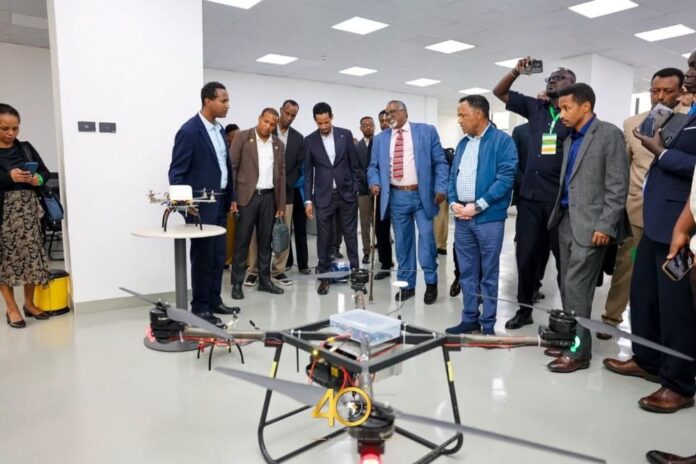
The commendation came during a high-level visit by IGAD member-state delegates to the Ethiopian Artificial Intelligence Institute in Addis Ababa. The visit took place on the sidelines of a regional consultation workshop dedicated to shaping the forthcoming IGAD Artificial Intelligence Framework and Strategy.
Addressing the delegates during the facility tour, IGAD Deputy Executive Secretary Mohamed Abdi Ware emphasized that artificial intelligence is no longer a distant futuristic luxury, but an urgent operational necessity. He noted that emerging technologies have become indispensable tools for achieving broad-based economic growth and addressing entrenched development challenges across the Horn of Africa.
Ware specifically highlighted Ethiopia’s deliberate progress in human development, foundational digital connectivity, and real-world AI deployment. By successfully integrating artificial intelligence across critical socio-economic sectors—including agriculture, healthcare, education, and finance—Ethiopia has established a robust ecosystem that positions the country to compete on the global stage, he added.
“Ethiopia’s practical applications and strategic approach to AI offer invaluable lessons and a viable model for neighboring countries,” Ware stated. He underscored that IGAD is actively seeking to forge deeper regional partnerships, enabling member states to draw directly from Ethiopia’s institutional experience and weave advanced AI solutions into their respective national development frameworks.
During the intensive site tour, delegates received a comprehensive briefing from Taye Girma, Deputy Director General of the Ethiopian Artificial Intelligence Institute. Girma walked the visiting officials through the institute’s core research, software development pipelines, and homegrown innovation initiatives.
Reiterating Ethiopia’s commitment to regional solidarity and technological equity, Girma affirmed that the institute stands ready to share its expertise, technical knowledge, and operational experience with all IGAD member states. He stressed that fostering collaborative technological initiatives will not only strengthen digital connectivity across East Africa, but will also allow nations to pool their intellectual and technical capabilities to tackle shared systemic vulnerabilities.
The delegation was given an up-close look at practical AI demonstrations spanning multiple domains. Officials explored how local machine learning models and smart automation tools are being deployed in precision agriculture, public health diagnostics, education delivery, judicial administration, and smart manufacturing. These exhibits vividly illustrated how digital transformation can radically streamline public services, reduce administrative friction, and accelerate macroeconomic development.
This regional push toward technology-driven resilience arrives nearly four decades after IGAD’s initial founding. Established in the mid-1980s primarily to combat recurring drought, severe desertification, and associated agrarian crises in the Horn of Africa, the organization has steadily broadened its strategic scope. As the region continues to grapple with increasingly complex economic pressures, environmental shocks, and social vulnerabilities, IGAD is turning decisively toward advanced digital tools as a primary driver for sustainable development and long-term climate resilience.
By leveraging Ethiopia’s expanding digital ecosystem and the institutional capacity of entities like the Ethiopian Artificial Intelligence Institute, the regional bloc aims to foster locally relevant, scalable AI solutions. Observers note that this deepening technological cooperation reflects a broader paradigm shift across East Africa. Rather than relying solely on traditional development models, nations in the region are increasingly embracing innovation, cross-border knowledge transfer, and digital integration as foundational pillars of regional cohesion and economic transformation.