The Kenyan government has frozen all new sugar import permits, asserting that domestic agricultural yields have risen high enough to completely fulfill national consumption requirements.
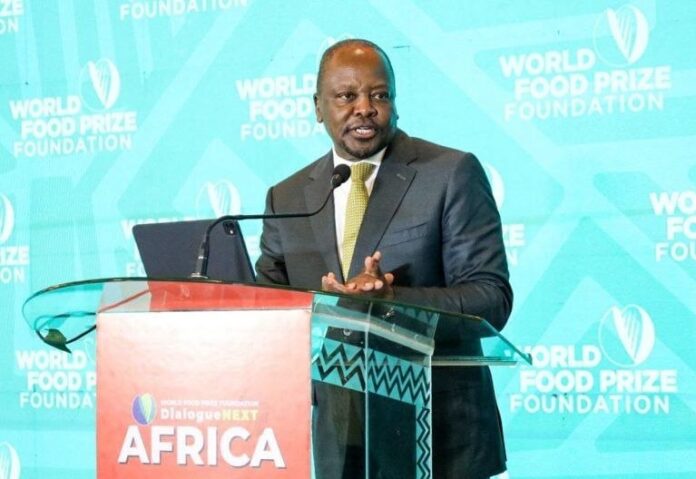
Agriculture and Livestock Development Cabinet Secretary Mutahi Kagwe made the declaration during an intensive stakeholders’ summit at Kilimo House. Addressing sugarcane farmers and executives from the Kenya Sugar Board (KSB), CS Kagwe confirmed that the ongoing prohibition on external sugar shipments stays firmly active. He stressed that state priorities are now heavily anchored on shielding local cultivators from predatory market competition and fortifying the domestic agricultural sector.
Kagwe reported that Kenya has crossed a major threshold by accumulating robust internal sugar reserves, rendering foreign purchases entirely unnecessary. Ministry statistics reflect an impressive reduction in external acquisitions, with shipments plummeting from an estimated 210,000 metric tonnes down to roughly 60,000 metric tonnes year-over-year.
Authorities credit this sharp decline to a surge in local harvests paired with strict regulatory measures, notably a Ksh 40 per kilogram excise duty established via the Finance Act. This tax barrier has successfully deterred massive speculative importing, giving native millers room to rebuild their market foothold.
“We will not issue any new licences for sugar imports because local production is now enough to satisfy the country’s market. Our priority is to protect our farmers and strengthen the local sugar industry,” Kagwe declared. He noted that the broader state vision is to pivot Kenya away from import dependency and position it as a net exporter of sugar.
Alongside the import freeze, the ministry is enacting tough regulatory overhauls across the sugarcane belt. To tackle destructive cane poaching that frequently breaks supply contracts, new factory licensing rules now mandate that prospective millers provide proof of an owned nucleus estate and a verified outgrower network prior to official authorization.
Concurrently, the administration is working to eliminate legacy financial burdens. Kagwe highlighted ongoing coordination with National Treasury Cabinet Secretary John Mbadi to wipe out the remaining historical payment arrears owed to growers, striving toward a completely debt-free farmer base.
The timing of the policy announcement aligns with preparations for the September 5, 2026, Kenya Sugar Board elections. These polls will elect five dedicated farmer representatives to the board, giving cultivators direct leverage over industry governance and policies outlined in the Sugar Act.
Farmer organizations, including the Kenya National Federation of Sugarcane Farmers led by Secretary General Kilion Osur, have praised the decision, noting that an active board is vital for implementing the Sugar Act, 2024, and overseeing funds like the Sugar Development Levy.
This protectionist stance also follows intense parliamentary probes into past trade practices. Recently, the National Assembly Departmental Committee on Trade, Industry and Cooperatives began probing raw sugar batches handled by Mombasa Sugar Refinery Limited. Legislators questioned roughly Ksh 3 billion in tax exemptions tied to the cargo, alongside incomplete compliance documentation regarding expiration dates and manufacturers.