Sudanese political forces have experienced a sharp divergence in positions regarding the latest international effort to launch a political process aimed at ending the country’s devastating war. While some civilian blocs chose to boycott the ongoing talks, others actively participated, seeking to shape the framework from within.
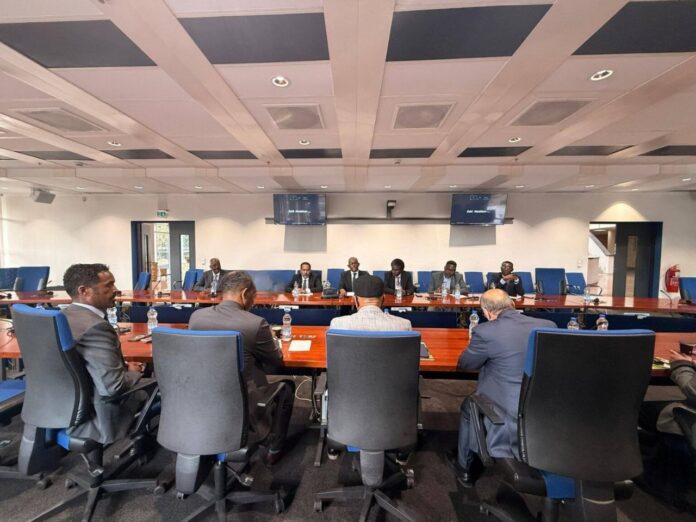
The high-stakes consultations, held in Addis Ababa, brought together the international “quintet” mechanism, which is comprised of the United Nations, the African Union, the Intergovernmental Authority on Development (IGAD), the Arab League, and the European Union. The mechanism sought to hold exploratory consultations and establish a preparatory committee for a broader political process to end the conflict. However, the meetings exposed deep-seated fractures among Sudanese civilian and political actors regarding ownership, inclusion, and priorities.
Represented by a delegation led by Dr. Maryam El Sadig El Mahdi, the National Umma Party outlined a strict roadmap for peace. The party asserted that any credible political process must begin with an immediate ceasefire, guaranteed civilian protection, unhindered humanitarian access, and confidence-building measures between warring Sudanese factions.
According to the Umma Party, these preliminary steps should pave the way for a comprehensive political and security settlement that addresses the root causes of the conflict. This would eventually lead to an inclusive national dialogue aimed at establishing sustainable peace and a democratic state founded on citizenship, justice, and the rule of law.
Furthermore, the party called on the quintet mechanism to unify its mandate, strengthen its structure, and expand its outreach to include a wider array of Sudanese political forces and experts. It emphasized that regional and international actors should strictly act as facilitators, supporters, and guarantors of the process, rather than imposing external political paths or solutions.
In contrast to the participating factions, several prominent civilian blocs opted out of the meetings entirely. These included the Sudanese Declaration of Principles forces, the Civil Democratic Alliance for Revolutionary Forces (Somoud), and the Sudan Founding Alliance (Tasees), which is aligned with the paramilitary Rapid Support Forces (RSF).
The boycotting groups heavily criticized the design of the process and the methodology behind issuing invitations. They insisted that Sudanese stakeholders—rather than international bodies—must set the agenda, determine participant eligibility, and decide the time and venue for negotiations. They also issued stern warnings against including political figures or factions accused of fueling the war, arguing that doing so would merely reproduce the crisis rather than resolve it.
Jaafar Hassan, a leader of the Somoud alliance, told Radio Dabanga that the five-party mechanism proceeded with committee preparations without addressing a fundamental failure to clearly identify the parties and issues involved.
Hassan reiterated that previous understandings had envisioned a genuinely Sudanese-owned process where international actors served strictly as facilitators, criticizing the mechanism for failing to properly distinguish between military actors and anti-war civilian forces.
Similarly, Kamal Omar Abdel Salam of the People’s Congress Party announced a total rejection of the process, warning that the approach risked smuggling figures and groups associated with the former National Congress Party and the Islamic Movement back into the political sphere. Omar argued that such inclusion would falsely equate groups responsible for starting the war and perpetuating authoritarian rule with those fighting for a democratic transition.
On the other side of the divide, the Democratic Bloc and the Coordination of National Forces chose to engage directly with the international representatives in Addis Ababa. During their meetings with UN envoys and European Union advisers, these participating groups laid out their specific conditions for peace.
Their discussions heavily emphasized the security situation on the ground. Participants called for political dialogue to transition into Sudan proper once security conditions allow, while urging the international community to prevent external support for armed groups and clearly distinguish between state institutions and rebel forces.
The consultations also exposed stark differences in priorities between international actors and domestic factions. While international representatives focused heavily on securing humanitarian truces and rapid access for aid, participating Sudanese blocs argued that security and a stable civilian life must come first. They explicitly linked the safe return of displaced persons and refugees to the total disarmament and withdrawal of RSF forces from civilian areas and cities.
Additionally, some participants urged the international community to classify the RSF as a terrorist organization, halt economic restrictions affecting vital national resources like gold exports, and guarantee meaningful representation for women, youth, and community groups in shaping Sudan’s political future.