
African electric vehicle manufacturers are beginning to redesign vehicles so that sunlight becomes a complementary onboard energy source rather than simply an external source of electricity.
The shift comes as engineers explore vehicle-integrated photovoltaics (VIPV), solar panels embedded into vehicle roofs and bodywork, as a practical way to supplement batteries, particularly in regions with abundant sunshine and still-developing charging infrastructure.
“There is a need for a vehicle with zero emissions,” according to Boubaker Siala, founder and CEO of Tunisia’s Bako Motors. He says the company’s solar-assisted electric vehicles respond to growing demand for cleaner transport while creating new commercial opportunities as environmental, social and governance (ESG) priorities become increasingly important for businesses and fleet operators.
Although Africa accounts for less than 2% of global installed solar generation capacity, it holds an estimated 40% of the world’s theoretical solar energy potential.
According to the World Bank’s Global Solar Atlas, Africa records the world’s highest average long-term photovoltaic yield at 4.51 kWh/kWp per day and is the only continent whose average exceeds the benchmark for “excellent” solar conditions. More than 85% of the continent receives annual solar irradiation above 2,000 kWh per square metre, allowing relatively small rooftop solar arrays to generate meaningful amounts of electricity.
Researchers from ETH Zurich and the Paul Scherrer Institute, in a July 2026 study, found that EVs supported by dedicated off-grid solar charging systems could become economically competitive across much of Africa before 2040.
After analysing more than 2,000 locations across 52 African countries, the researchers concluded that compact solar installations could reliably support a small electric vehicle travelling about 50 kilometres a day, suggesting the continent’s solar resource could become a competitive advantage for electric mobility.
The findings come as improvements in lightweight photovoltaic cells, battery technology and power electronics make vehicle-integrated solar increasingly practical for extending driving range and powering auxiliary systems, even though rooftop panels remain too small to replace plug-in charging altogether.
Yet engineers remain divided over how far the technology can go.
“I’m afraid it’s not really headed towards mass adoption,” according to Tom Courtright, an independent e-mobility consultant who has tracked Africa’s electric mobility sector for years. “It’s just generally not really worth the cost, doesn’t give that much power being that small, and creates its own problems.”
The scepticism reflects a broader engineering debate around vehicle-integrated photovoltaics. Because a car roof offers relatively little surface area for solar cells, integrated panels generate only modest amounts of electricity compared with standalone solar installations. In practice, the technology is generally viewed as a way to supplement batteries, power auxiliary systems and provide incremental range gains rather than replace plug-in charging altogether.
Among Africa’s early commercial adopters is Tunisia’s Bako Motors, which has developed electric vehicles that integrate rooftop solar panels to supplement lithium iron phosphate batteries.
Its compact Bako Bee, designed for urban mobility, delivers between 70 and 120 kilometres of range while using onboard solar energy to minimise charging top-ups.
“Approximately 50% of our business activities are dedicated to exporting to Europe, and the rest is local to the Tunisian market,” according to Siala.
The company recently completed its maiden export delivery of the Bee to Italy, marking one of the first commercial deployments of a solar-assisted African-designed electric vehicle into Europe.
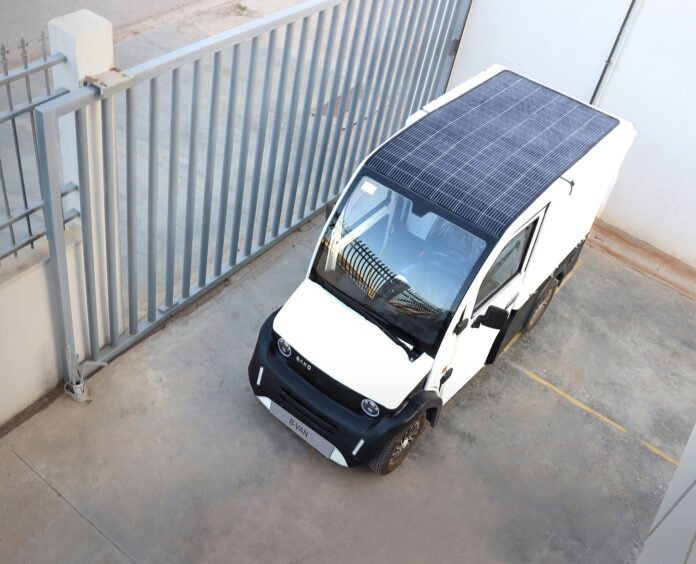
Bako is also expanding the concept into commercial logistics through the B-Van, a last-mile delivery vehicle offering up to 300 kilometres of range, 1,320 litres of cargo capacity and a 400-kilogram payload.
Its integrated solar roof supplies supplementary energy that helps reduce charging frequency while powering onboard systems such as refrigeration, lighting and air conditioning.
The company is scaling production through a new factory in Kalâat El Andalous targeting 8,000 vehicles annually, with around 80% destined for export markets including Italy, Germany and France. It also operates a manufacturing facility in Saudi Arabia serving Gulf markets, reflecting growing international interest in its solar-assisted vehicle strategy.
The trend is also attracting international manufacturers looking at African markets. Chinese manufacturer Solarky Mobility Technologies is preparing to enter South Africa with its sunV, which it describes as the world’s first mass-produced solar-assisted electric vehicle.
Already operating in Tanzania, Thailand and Indonesia, the company has equipped the compact four-seater with a 10.2 kWh lithium iron phosphate battery and an extendable rooftop photovoltaic system that expands from 1.6 to 3.2 square metres.
According to the company, the solar array can generate enough electricity under favourable sunlight to add up to 50 kilometres of driving per day, reducing reliance on plug-in charging for urban commuters.
Africa’s experiments extend well beyond commercial startups.
Uganda’s Kiira Motors, which grew out of engineering research at Makerere University, equipped its Kayoola Solar Bus with roof-mounted solar panels that continuously recharge onboard battery banks and extend operating range.
In Kenya, Solar-e-Cycles integrated a 300-watt photovoltaic roof into its Uhuru electric tricycle to supplement battery power while supporting productive uses including off-grid refrigeration and household electricity.
South African universities are also helping advance the technology. Tshwane University of Technology’s SunChaser Solar Car Project has become one of Africa’s leading university-led solar mobility programmes, using student-designed vehicles as platforms for research into lightweight engineering, energy management systems and vehicle-integrated photovoltaics.
The project gained international recognition in September 2025 when it won the International Council of Academies of Engineering and Technological Sciences (CAETS) Communication Prize.
“The Solar Car Project is a story of resilience, innovation and engineering excellence. It is a call to the next generation to push boundaries, embrace sustainable technology and reimagine the future of mobility,” said Prof. Ben van Wyk, the university’s Deputy Vice-Chancellor for Teaching, Learning and Technology.
Although still niche, these initiatives reflect a growing engineering philosophy in which solar panels complement, rather than replace, rechargeable batteries.
Vehicle design is only one side of that transition. Across East Africa, charging infrastructure is also beginning to incorporate solar generation.
Burundi recently commissioned one of the region’s first fully solar-powered electric vehicle charging stations through a partnership involving Growth Energy, GEM e-Mobility and Solio Group, demonstrating how renewable electricity generation and transport infrastructure are beginning to evolve alongside advances in vehicle engineering.
The movement mirrors a broader global shift. In the United States, Aptera Motors is developing an ultra-lightweight three-wheeled electric vehicle fitted with around 700 watts of integrated solar cells, which the company says can harvest up to 40 miles (64 kilometres) of off-grid driving range per day under favourable conditions.
Germany’s Sono Motors has pivoted from building passenger cars to supplying solar retrofit kits for municipal buses, refrigerated trailers and delivery vans, enabling rooftop solar panels to feed electricity directly into high-voltage traction batteries. In the Netherlands, Lightyear has shifted from developing premium solar cars to supplying high-efficiency integrated photovoltaic systems to automotive manufacturers, reflecting growing industry interest in solar-assisted vehicle technology.
Africa’s emerging experiments therefore form part of a wider engineering direction, but one shaped by the continent’s combination of abundant sunshine, growing transport demand and still-developing charging networks.
According to a 2025 analysis by the Energy for Growth Hub, Africa’s vehicle fleet could double by 2050, with motorisation rising from 73 to 150 vehicles per 1,000 people as incomes grow and urbanisation accelerates.