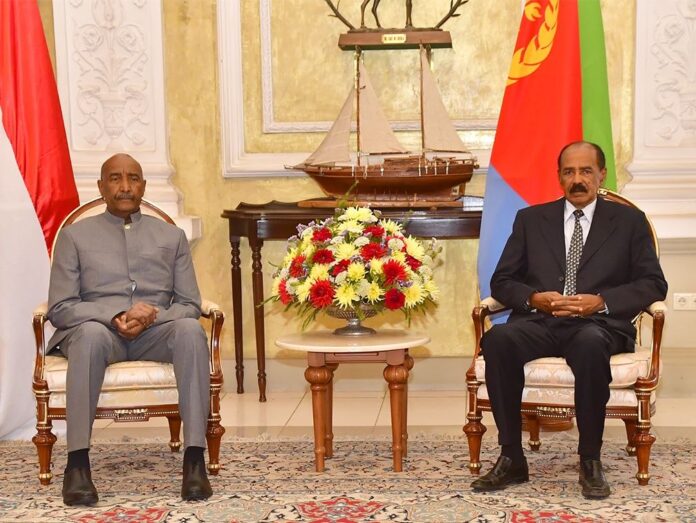
Eritrean President Isaias Afwerki held high-level talks on Friday with the Chairman of Sudan’s Transitional Sovereignty Council, General Abdel Fattah al-Burhan. This meeting is described as an indication of the shifting geopolitical alignments across the Horn of Africa as the Sudanese conflict enters its third year.
As confirmed by Eritrea’s Minister of Information, Yemane G. Meskel, President Isaias received al-Burhan and his delegation at the State House in Asmara for “extensive talks on bilateral ties, the current situation in Sudan, and regional and international issues of mutual interest.”
The talks took place against the backdrop of the devastating civil war that erupted in April 2023 between the Sudanese Armed Forces (SAF), led by al-Burhan, and the Rapid Support Forces (RSF), under General Mohamed Hamdan Dagalo. The conflict has created one of the world’s worst humanitarian crises, claiming tens of thousands of lives and displacing millions.
Analysts have characterized the Sudanese war as a “harbinger of future conflicts,” noting that it is complex, protracted, and influenced by competing outside powers with often irreconcilable interests. It is reported that the United Arab Emirates provides support to the RSF via Chad, while Saudi Arabia supports the SAF in order to preserve state institutions. Turkey and Egypt have also aligned themselves with the Sudanese military, further internationalizing the conflict.
Eritrea’s engagement with Sudan reflects broader regional dynamics that have intensified since the outbreak of the Sudanese conflict. As a coastal nation on the Red Sea, Eritrea occupies a strategically vital position that attracts significant attention from Gulf states. The country has previously allowed its territory to be used as a staging ground by the United Arab Emirates during the Yemen war.
President Isaias has been strengthening ties with Red Sea coastal nations and recently visited Saudi Arabia and Egypt. A few weeks before al-Burhan’s visit, Eritrean officials met with Sudanese Minister of Finance Gibril Ibrahim and Minister of Information Khalid Aleisir to discuss strengthening cooperation and regional security.
The Eritrean leader reaffirmed his country’s support for Sudan’s security and stability, while Sudanese officials expressed their gratitude for Eritrea’s support for Sudanese citizens affected by the conflict. Sudanese nationals have been granted special privileges in Eritrea, including fee exemptions and freedom of movement.
Geopolitical analysts agree that the meeting between Isaias and al-Burhan must be viewed in the context of shifting alliances across the Horn of Africa and the Red Sea region. The area has become a “hub of geo-strategic rivalry,” with a Saudi-Turkey-Pakistan axis on one side, and an Israel-UAE-India bloc on the other, both attempting to project influence through proxy engagements in conflicts ranging from Somalia to Sudan.
The coastal states of the Horn of Africa have demonstrated significant agency in navigating these external pressures. Despite their relative weaknesses, Eritrea, Sudan, and Somalia have maintained “sufficient autonomy” to steer their external relations according to their own national interests.
General al-Burhan’s visit to Asmara is seen as an effort to consolidate regional support amid the ongoing military stalemate. The Sudanese conflict has effectively partitioned the country, creating parallel administrations between the RSF in Darfur and the SAF in Khartoum.
The visit comes at a time of heightened tension involving Eritrea’s neighbor, Ethiopia, which is actively seeking maritime access. Ethiopia’s interest in the Red Sea has become central to diplomatic maneuvering in the region, particularly after Addis Ababa signed a memorandum of understanding with Somaliland in 2024, a move that has further complicated the regional balance of power.
Earlier this year, President Isaias met with Egyptian President Abdel-Fattah al-Sisi in Cairo to discuss bilateral ties and regional security. President al-Sisi affirmed his support for Eritrea’s sovereignty and territorial integrity, while President Isaias expressed his desire to deepen cooperation with Egypt.