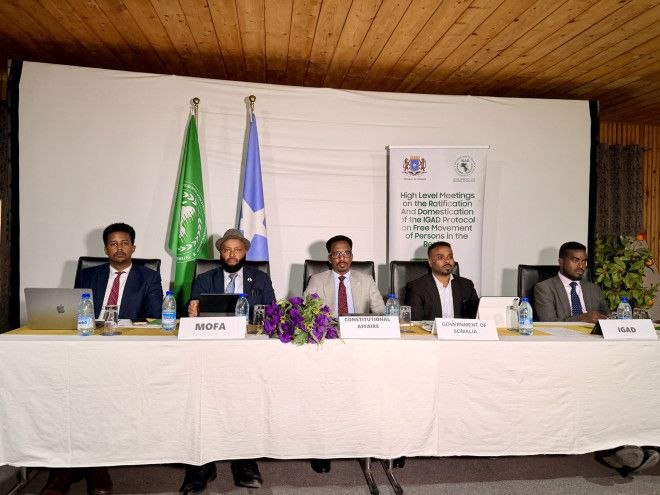
The Intergovernmental Authority on Development (IGAD) has officially launched a series of high-level consultations in Mogadishu. The three-day summit brings together government officials, policy experts, and key stakeholders to map out a clear path for the ratification, domestication, and eventual implementation of the IGAD Protocol on Free Movement of Persons.
The consultations represent a pivotal moment for the Horn of Africa, as member states look to harmonize their legal frameworks to facilitate the seamless movement of people, labor, and goods. For Somalia, which signed the landmark protocol on March 5, 2023, the meetings serve as a critical forum to define national responsibilities and align domestic laws with regional objectives.
The primary agenda of the three-day conference centers on the “IGAD Protocol on Free Movement of Persons,” an ambitious initiative designed to allow citizens of member states the right to enter, reside, work, and study across borders without the bureaucratic hurdles that currently exist. Central to these discussions are two transformative tools: the implementation of an IGAD Interoperable ID and the development of a unified “IGAD Single Visa” system.
Dr. Mohamoud Kaarshe, IGAD’s head of mission to Somalia, underscored the urgency of the initiative. He noted that cross-border movement is already a daily reality for millions in the region—whether for business, education, family reunification, or escaping the pressures of climate-related disasters.
“People across the region are already moving,” Dr. Kaarshe explained during the opening sessions. “Our objective as an authority is not to stop this flow, but to ensure that it is governed by secure, predictable, and well-coordinated legal frameworks that benefit both the citizens and the security interests of member states.”
For the Federal Government of Somalia, hosting these consultations is a reflection of the nation’s evolving role on the continental stage. Abdulkadir Mahmoud Yusuf, the director of the Africa Department at Somalia’s Ministry of Foreign Affairs, emphasized that the country is shedding its image of isolation to become a central pillar of regional trade and diplomacy.
“We are pleased to host a conference of this nature here in Mogadishu,” said Yusuf. “This forum is about more than just bureaucracy; it is about reinforcing Somalia’s position as a strategic hub for trade and regional connectivity. By integrating our systems with our neighbors, we are opening doors for our citizens and contributing to a more stable and prosperous Horn of Africa.”
While the promise of free movement offers vast economic potential, officials remain mindful of the complex security landscape in the region. A recurring theme throughout the discussions has been the balance between regional openness and national security. The proposed roadmap aims to create a “harmonized framework” that enables mobility while simultaneously strengthening border management and law enforcement cooperation.
Proponents of the protocol argue that the interoperable ID system will actually enhance regional security by creating a shared database that allows member states to verify identities more effectively, thereby reducing the prevalence of undocumented or illegal transit.