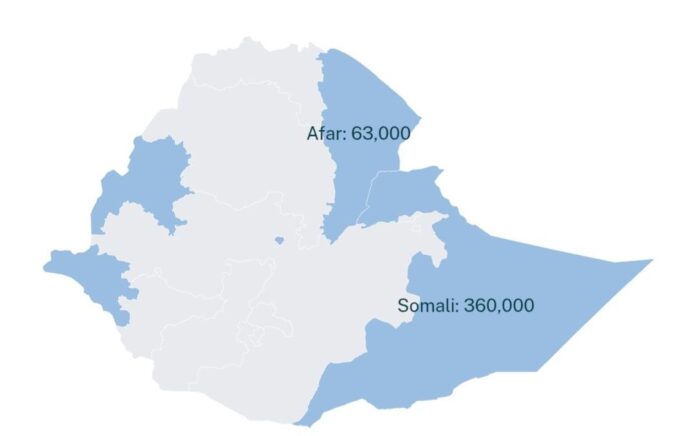
In early 2025, the Ethiopian government introduced a bold, forward-looking vision for the management of the more than 1.1 million refugees and asylum seekers residing within its borders. Known as the “Makatet” framework—the Amharic word for “inclusion”—the policy aims to pivot away from the traditional, isolated model of refugee camps toward a model of self-sustainability. By integrating refugees into national education, health care, and employment systems, the Ethiopian government hopes to reduce the burden of parallel humanitarian delivery and foster long-term resilience for both displaced populations and host communities.
However, as of mid-2026, the ambitious roadmap faces a precarious future. While the initiative has been lauded by international organizations and foreign governments as a promising model for global refugee management, it is being severely undercut by a reality of mounting global instability, donor fatigue, and acute funding shortages.
The Makatet framework is designed to consolidate a decade of efforts to move refugees out of the border-area camps that have historically characterized Ethiopia’s response to displacement. The policy is comprehensive, aiming to provide refugees with work permits, business licenses, and access to national systems through the country’s new biometric ID, Fayda. By treating refugees as an investment in local economies rather than a drain on humanitarian resources, advocates, including former UN High Commissioner for Refugees Filippo Grandi, have praised the move as a necessary evolution in refugee hosting.
In theory, the framework dissolves the need for segregated, inefficient service-delivery systems. It suggests a future where a refugee child sits in the same classroom as an Ethiopian national, and a refugee entrepreneur holds the same business license as a local citizen.
Despite the logical appeal of this shift, the transition is proving prohibitively expensive. The integration of over 1.1 million new users into national health and education systems requires significant capital investment, which is currently absent. Ethiopia’s own national systems are already under severe strain, with existing shortages of teachers and medical personnel.
The consequences of this financial deficit are already visible on the ground. In 2024, a projected $4.4 million funding shortfall resulted in 187,000 refugee students being left without access to schools. As the government attempts to transition school management from nongovernmental organizations (NGOs) to regional education bureaus, the lack of resources has led to uncertainty regarding the quality of education and the retention of qualified teachers.
The western Gambella region, which hosts hundreds of thousands of refugees from South Sudan, serves as a stark warning. With refugees there almost entirely dependent on international aid, recent cuts in foreign assistance have created a humanitarian vacuum. Local officials report that the national budget for essential services remains tied solely to the number of Ethiopian citizens, with no additional allocation for the millions of refugees now residing in those regions. Without a substantial influx of international funding, the “integration” promised by Makatet threatens to turn into a scenario of shared scarcity rather than shared opportunity.
The crisis of funding is compounded by a crisis of scope. The Makatet framework, while progressive in its language, has not been applied universally. Most notably, tens of thousands of Eritreans residing in Addis Ababa have been largely sidelined. Due to shifting political dynamics and the end of prima facie status for Eritreans in 2020, many have fallen into a legal limbo, unable to obtain the documentation required to access the very systems that Makatet aims to open.
For these individuals, the “inclusion-first” agenda is a mirage. Without the Fayda ID or legal work authorization, these refugees remain trapped in a cycle of poverty, vulnerable to arbitrary arrest, extortion, and deportation. Reports of police cracking down on these communities—often motivated by the incorrect assumption that all Eritreans have access to significant financial remittances—have created a climate of fear. For them, the shift toward state-led management has, in some instances, led to increased surveillance rather than increased security.
The documents show that, Ethiopia moves deeper into the implementation of the five-year Makatet roadmap, the path ahead remains treacherous. The success of the policy hinges on a fragile bargain: the Ethiopian government is willing to open its doors and its systems, but only if the international community provides the financial infrastructure to sustain them.
As global crises proliferate and donor countries turn inward, the burden on Ethiopia continues to mount. Without a more robust commitment from international donors, and without addressing the legal exclusion of specific vulnerable groups, the Makatet framework risks failing to meet the very humanitarian standards it was designed to uphold.