By HER staff reporter
Africa’s ambition to expand digital trade is being tested by limited connectivity, costly cross-border payments and shortages of digital skills, as the global services economy moves rapidly toward digitally deliverable exports.
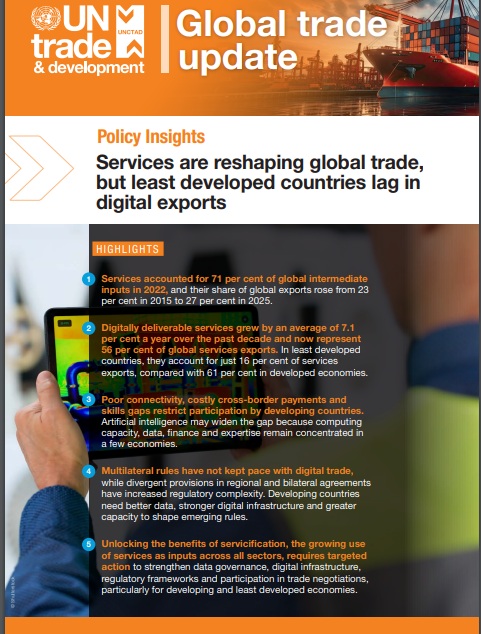
A new policy analysis by the United Nations Conference on Trade and Development (UNCTAD) says digitally deliverable services now account for 56 per cent of global services exports. The sector—including financial, telecommunications, computer, professional, research and business services—grew by an average of 7.1 per cent annually over the past decade.
However, least developed countries have captured only a small share of this expansion. Digitally deliverable services account for just 16 per cent of their services exports, compared with about 61 per cent in developed economies. Their share of global services exports also fell to 0.6 per cent in 2025, despite the broader growth of international services trade.
For Africa, the gap presents both a development challenge and an opportunity. Countries with reliable broadband networks, affordable digital services, modern payment systems and appropriately trained workers could use digital exports to diversify beyond commodities and traditional services such as transport and tourism.
Services reshape global trade
Services are increasingly embedded in the production and export of goods. Logistics, finance, design, marketing, data management and research are now essential inputs for manufacturers, farmers and exporters.
UNCTAD estimates that services accounted for 71 per cent of global intermediate inputs in 2022. Their share of global exports rose from 23 per cent in 2015 to 27 per cent in 2025. But the contribution of services remains uneven: services accounted for 61 per cent of intermediate inputs in developing economies, compared with 78 per cent in developed economies.
The difference is especially pronounced in industrial exports. Services represented 33 per cent of intermediate inputs in industrial goods exports from developed economies, but only 27 per cent in developing countries and 13 per cent in the least developed countries covered by the available data.
This means that countries with stronger service industries can capture more value from manufacturing, agriculture and commodity exports. A competitive agricultural exporter, for example, depends not only on production but also on financial services, digital platforms, quality certification, insurance, logistics and market intelligence.
Digital payments remain a barrier
Access to international payment systems is essential for companies and freelancers selling services across borders. Yet high transaction costs, limited interoperability and weak consumer-protection mechanisms continue to restrict participation by smaller African businesses.
UNCTAD says progress is being made in Africa. Mobile-money use among adults in sub-Saharan Africa increased from approximately 27 per cent in 2021 to about 40 per cent in 2024. The Pan-African Payment and Settlement System, or PAPSS, is also helping reduce cross-border transaction costs and limit dependence on offshore clearing systems.
Despite these gains, many businesses still face difficulties receiving payments from foreign customers, connecting digital platforms to local bank accounts and resolving disputes. The constraints are particularly serious for micro, small and medium-sized enterprises, which often lack the resources to navigate complex payment and compliance requirements.
A more integrated African payments environment could support intra-African trade, help businesses reach customers beyond their home markets and improve the prospects of exporting software, consulting, creative content, education and other professional services.
AI could widen the divide
Artificial intelligence could create new opportunities for African businesses, but UNCTAD warns that it may also deepen existing inequalities.
AI development depends on computing capacity, reliable infrastructure, access to data, investment capital and highly skilled workers. These resources remain concentrated in a relatively small number of countries and companies. The UNCTAD analysis cites an International Monetary Fund index showing that average AI preparedness was 0.31 for least developed countries, compared with 0.65 for developed economies.
The technology could raise productivity and reduce the cost of delivering digital services. At the same time, it could automate routine and lower-skilled tasks that have provided an entry point for developing countries into global services markets.
For African economies, the policy challenge is therefore not simply to adopt AI, but to build the conditions that allow local firms and workers to benefit from it. This includes investment in broadband, data infrastructure, research, digital education and national AI strategies.
Rules are evolving unevenly
The global regulatory framework for digital trade has not kept pace with the expansion of the digital economy. UNCTAD says multilateral rules remain limited, while digital trade provisions are increasingly being negotiated through regional, bilateral and plurilateral agreements.
The resulting patchwork can be difficult for smaller firms and developing-country governments to navigate. Different rules on data protection, electronic transactions, consumer protection and digital taxation may increase compliance costs and discourage cross-border activity.
At the World Trade Organization’s 14th Ministerial Conference in March 2026, 66 members advanced an Agreement on Electronic Commerce. Separately, 24 members pledged to maintain a moratorium on customs duties on electronic transmissions and agreed on a common definition of such transmissions. However, participation in these initiatives remains uneven, with many African and least developed countries outside the main rulemaking processes.
The report says that of 487 preferential trade agreements signed between 2000 and 2025, 55 per cent included e-commerce or digital trade provisions. Since 2020, 62 per cent of developing countries and 66 per cent of least developed countries have participated in preferential trade agreements containing digital trade provisions, compared with 90 per cent of developed countries.
A policy agenda for Africa
UNCTAD identifies three priorities for countries seeking to benefit from the growth of services trade: better data, stronger digital foundations and more inclusive international cooperation.
African governments need more detailed information on services exports, trading partners, sectors and the ways in which services are supplied. Without reliable data, policymakers cannot identify competitive industries, measure the contribution of digital trade or negotiate effectively.
Infrastructure investment is equally important. Affordable broadband, dependable electricity, digital identification, interoperable payment systems and practical digital skills will determine whether African firms can participate in international markets.
Finally, African countries need a stronger collective voice in the development of digital trade rules. Regional coordination through the African Continental Free Trade Area could help reduce regulatory fragmentation and promote common approaches to digital transactions, data governance and consumer protection.
Africa’s digital trade future will not be determined by technology alone. It will depend on whether governments can build the infrastructure, skills, financial systems and rules required to turn connectivity into productive economic participation. As services become increasingly central to global trade, closing that gap will be critical to the continent’s diversification and development prospects.